

- Frame technology as operational efficiency, not innovation
- Show projected labor savings with specific hours and dollar amounts
- Include an implementation timeline that proves you've thought it through
- Use the business plan template outline below to write yours in a weekend
Your Business Plan Has a Technology Problem
You want to invest in AI and automation for your business.
You know it'll save time. You know it'll reduce costs. You know it'll help you scale.
But when you sit down to write the technology section of your SBA business plan, you freeze.
Because "I want to use AI" doesn't get loans approved.
Lenders don't fund cool ideas. They fund operational improvements with measurable returns. And most business owners write their tech section like a pitch deck for a Silicon Valley startup instead of a financial case for a local bank.
Here's how to fix that.
The Mistake Most Business Owners Make
They write something like this:
"We plan to implement artificial intelligence tools to modernize our operations and stay competitive in an evolving marketplace."
That tells the lender nothing.
Nothing about cost. Nothing about return. Nothing about timeline. Nothing about what specific problem it solves.
It sounds like a buzzword salad. And the loan officer reading your application has seen 200 of these this month.
According to the SBA, a strong business plan needs to demonstrate "your strategy for making money." Technology is only relevant when it connects directly to revenue or cost reduction.
Your tech section needs to read like an accountant wrote it, not a tech blogger.
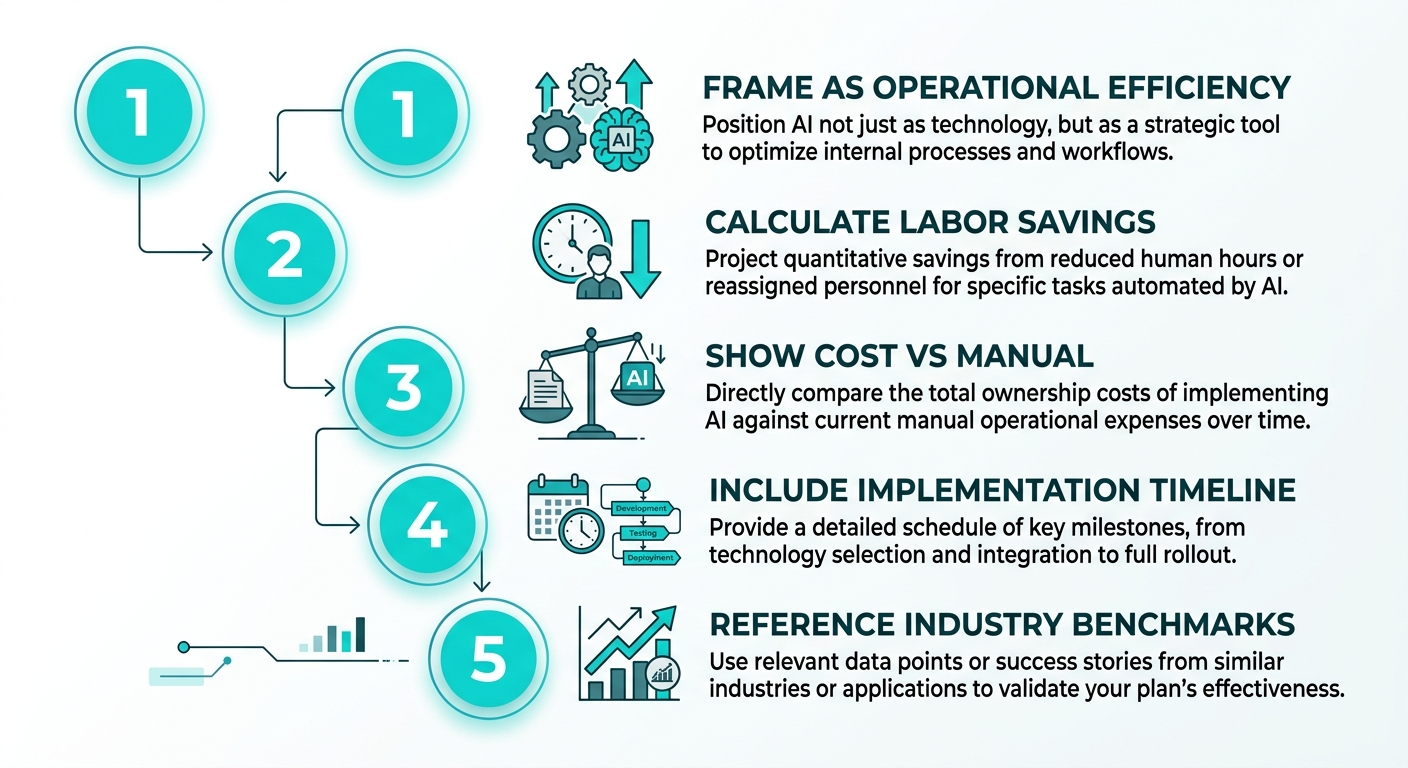
The 5-Part Framework for Your Technology Section
1. Frame AI as Operational Efficiency, Not "Cool Tech"
Lenders understand efficiency. They understand labor costs. They understand time savings.
They do not understand "leveraging machine learning to optimize customer touchpoints."
Instead of this:
"We will deploy an AI-powered chatbot to handle customer interactions."
Write this:
"We will implement an automated customer response system that handles initial inquiries, books appointments, and follows up with leads. This replaces 25 hours per week of manual phone and email follow-up currently performed by a $45,000/year administrative employee."
See the difference?
One sounds like a tech pitch. The other sounds like a business decision.
Use words like:
- Automated system (not AI)
- Operational efficiency (not digital transformation)
- Labor cost reduction (not innovation)
- Process standardization (not machine learning)
The technology is the same. The framing is what gets it approved.
2. Include Projected Labor Savings With Specific Hours
Lenders want numbers. Specific ones.
Here's how to calculate your projected savings:
Step 1: List every manual task you plan to automate.
| Task | Hours/Week | Annual Hours | Hourly Cost | Annual Cost |
|---|---|---|---|---|
| Lead follow-up emails | 8 | 416 | $22 | $9,152 |
| Appointment scheduling | 5 | 260 | $22 | $5,720 |
| Invoice generation | 3 | 156 | $22 | $3,432 |
| Customer intake forms | 4 | 208 | $22 | $4,576 |
| Social media posting | 6 | 312 | $22 | $6,864 |
| Total | 26 | 1,352 | $29,744 |
Step 2: Calculate the cost of automation.
- Platform subscription: $297/month = $3,564/year
- Implementation and setup: $5,000 one-time
- Training: $1,500 one-time
- Year 1 total: $10,064
- Year 2+ total: $3,564/year
Step 3: Show the ROI.
- Year 1 savings: $29,744 - $10,064 = $19,680 net savings
- Year 2 savings: $29,744 - $3,564 = $26,180 net savings
- 3-year ROI: $72,040 in total savings
That's the kind of math that gets loans approved. A McKinsey report found that AI-driven automation can boost small business productivity by 20-30%. Include that benchmark.
Want help calculating your specific numbers? Our ROI calculator runs the math for your business in under 5 minutes.
3. Show the Cost vs. Manual Equivalent
This is where you make the lender's decision easy.
Create a side-by-side comparison:
Option A: Hire additional staff
- 1 full-time admin assistant: $45,000/year + benefits (~$12,000) = $57,000/year
- Training time: 2-3 months before full productivity
- Capacity: 40 hours/week, limited to business hours
- Scalability: Need another hire at next growth stage
Option B: Implement automation platform
- Year 1 cost (platform + setup): $10,064
- Capacity: 24/7/365, handles unlimited volume
- Scalability: Same cost at 2x or 3x volume
- Time to full operation: 4-6 weeks
Cost difference over 3 years:
- Hiring: $171,000
- Automation: $17,192
- Savings: $153,808
No loan officer is going to argue with $153K in savings over three years. That's not a technology pitch. That's a business case.
4. Include an Implementation Timeline
This is the part most people skip. And it's the part that separates serious applications from wish lists.
Lenders want to see that you've actually thought through how this gets done.
Sample Implementation Timeline:
| Phase | Timeline | Milestone |
|---|---|---|
| Platform selection and contract | Week 1-2 | Vendor selected, contract signed |
| CRM setup and data migration | Week 2-4 | Customer data imported, pipelines configured |
| Automation workflows built | Week 4-6 | Lead follow-up, booking, and invoicing automated |
| Staff training | Week 6-7 | Team trained on new system |
| Testing and refinement | Week 7-8 | All workflows tested with live data |
| Full deployment | Week 8 | System live, manual processes retired |
| 90-day review | Week 20 | ROI metrics evaluated against projections |
A detailed timeline tells the lender three things:
- You've done your homework
- The risk is low because the plan is specific
- Results are measurable and time-bound
Need help building your implementation plan? Book a free consulting session and we'll map it out with you.
5. Reference Industry Benchmarks
Don't just use your own projections. Back them up.
Industry stats that strengthen your case:
- 67% of small businesses that adopt automation see positive ROI within 12 months (Salesforce State of Small Business Report)
- Small businesses using CRM automation report 29% increase in sales (Nucleus Research)
- AI-powered customer service reduces support costs by up to 30% (IBM)
- Businesses that automate lead follow-up respond 80x faster than manual processes
- The average small business spends 23% of their workday on manual tasks that could be automated (Zapier)
Include 3-5 of these in your plan. They tell the lender this isn't a gamble. It's an industry-proven strategy.
The Business Plan Technology Section Template
Here's the template outline. Copy it. Fill it in. Submit it.
Section: Technology and Operations Investment
1. Current Operations Assessment
- Describe current manual processes and their costs
- Identify bottlenecks and inefficiencies
- Quantify time spent on tasks targeted for automation
2. Proposed Technology Solution
- Describe the specific systems (CRM, automation platform, AI tools)
- Explain what each system replaces or improves
- Use operational language, not tech jargon
3. Financial Projections
- Total implementation cost (Year 1)
- Ongoing annual cost (Year 2+)
- Projected labor savings (annual)
- Net ROI by year (Year 1, Year 2, Year 3)
- Break-even point
4. Implementation Plan
- Phase-by-phase timeline with milestones
- Vendor/partner identified (if applicable)
- Staff training plan
- Performance metrics and review schedule
5. Risk Mitigation
- Vendor reliability and support
- Data security measures
- Fallback plan if implementation delays occur
- Staff transition plan
6. Industry Validation
- 3-5 industry benchmarks supporting the investment
- Competitor analysis showing technology adoption trends
- Market data on automation ROI for your sector
Where to Find SBA Lenders Who Get It
Not all lenders are the same. Some have never approved a technology investment. Others specialize in it.
Use SBA Lender Match to find approved SBA lenders in your area. It's free, takes 5 minutes, and matches you with lenders based on your specific loan needs.
When you talk to lenders, ask:
- "Have you approved loans that include technology or software investments?"
- "What documentation do you need for the technology section?"
- "Do you have preferred vendors or implementation partners?"
The right lender makes this process 10x easier.
If you're comparing loan types, read our breakdown of SBA 7(a) vs. Microloans for AI investment to pick the right program before you apply.
The Biggest Mistake: Waiting Until You "Need" It
Most businesses apply for SBA loans when they're already struggling. Cash is tight. Growth has stalled. They're reactive.
The best time to invest in automation is when things are going well. When you have revenue to show. When your projections are based on growth, not survival.
Your business plan should tell a growth story, not a rescue story.
And the numbers are on your side. Businesses that invest in AI and automation early report higher profit margins within 18 months compared to those who wait.
Already exploring other funding options? Check out our full guide to SBA loans for AI and automation or our comparison of every financing option available.
Write It This Weekend
You don't need a consultant to write your business plan. You need a framework.
You've got the framework now.
Spend Saturday morning on the numbers. Sunday afternoon on the narrative. Monday, submit it to a lender.
The businesses that win aren't the ones with the best technology. They're the ones that know how to explain why it matters.
And now you know how.
Ready to build the business case for your AI investment?
We help small business owners calculate their automation ROI, map their implementation plan, and write the technology section that gets loans approved.
Book a free system audit and we'll show you exactly what to include in your plan.
Ready to Automate Your Business?
Book a free strategy call and we'll map out exactly what to build first.
Book Your Call
Join the Conversation