
- SBA 7(a), microloans, 504, and Express each serve different needs
- SBIR grants give you free money if you qualify
- Section 179 lets you deduct the full cost in Year 1
- Vendor financing and 0% intro APR cards are underrated options
- Use the decision tree at the bottom to pick the right path
You Can't Afford NOT to Automate. But How Do You Pay for It?
The ROI on AI and automation is proven. We've covered that.
Businesses save 20-30% on labor costs. Response times drop from hours to seconds. Revenue goes up because you stop losing leads to slow follow-up.
But knowing the ROI doesn't put money in your account today.
You need to fund the investment first. And most business owners think they have two options: pay cash or get a bank loan.
You actually have at least ten.
Let's go through every single one.
1. SBA 7(a) Loans
Best for: $25,000 - $5,000,000 investments. Mixed-use funding (technology + working capital + subscriptions).
The 7(a) is the Swiss Army knife of SBA loans. It covers almost everything.
Key details:
- Maximum: $5 million
- Interest rates: Prime + 2.25-4.75% (currently ~10-13%)
- Terms: Up to 10 years for equipment/technology, 25 years if real estate is included
- Down payment: 10-20%
- SBA guarantee: 75-85%
- Timeline: 30-60 days
What it funds:
- Software subscriptions (yes, including SaaS)
- Custom software development
- Hardware and equipment
- Implementation and consulting fees
- Working capital during transition
- Training costs
Why it works for AI: The 7(a) is the only SBA loan that comfortably funds ongoing SaaS costs. If your AI stack is primarily subscription-based - CRM, automation platform, chatbot, analytics - this is the one.
The catch: Higher interest rates than the 504 and more paperwork than Express. You'll need a solid business plan with a technology section to get approved.
Read our full breakdown: SBA loans for AI and automation
2. SBA Microloans
Best for: Under $50,000 investments. First-time borrowers. Businesses under 2 years old.
Microloans are the entry point to SBA financing. Simple application. Faster approval. Lower barrier.
Key details:
- Maximum: $50,000 (average is ~$13,000)
- Interest rates: 8-13%
- Terms: Up to 6 years
- Collateral: Varies by lender, often minimal
- Timeline: 2-4 weeks
What it funds:
- CRM platform setup
- Chatbot implementation
- Basic automation tools
- Equipment and supplies
- Working capital
Why it works for AI: If you're a smaller business making your first automation investment, $10,000-$30,000 is often enough to fund a CRM, chatbot, and basic automation workflows. A microloan gets you there without the heavyweight application process.
The catch: The $50K cap means this won't cover major infrastructure builds. And not all lenders offer microloans - they're distributed through nonprofit intermediary lenders.
Comparison: SBA 7(a) vs. Microloans for AI
3. SBA 504 Loans
Best for: $100,000+ major fixed asset investments. Servers, custom platforms, technology infrastructure.
The 504 is the big gun. Designed for major capital investments with a unique three-way funding structure that gives you the lowest down payment and interest rates.
Key details:
- Maximum: $5-5.5 million
- Interest rates: Fixed, below market on the CDC portion (~5.5-6.5%)
- Terms: 10, 20, or 25 years
- Down payment: Just 10%
- Timeline: 60-90 days
What it funds:
- Servers and hardware infrastructure
- Custom software with 10+ year useful life
- Technology equipment
- Commercial real estate for tech operations
What it does NOT fund:
- SaaS subscriptions
- Working capital
- Short-lived technology
Why it works for AI: If you're making a big infrastructure play - on-premises AI servers, a custom-built platform, a major equipment purchase - the 504 saves you serious money on interest and down payment.
Full deep dive: SBA 504 Loans for Technology
4. SBA Express Loans
Best for: $50,000 - $500,000 investments where speed matters.
Same program as the 7(a), but streamlined. The SBA responds to lender applications within 36 hours.
Key details:
- Maximum: $500,000
- Interest rates: Same as 7(a) (prime + 4.5-6.5%)
- Terms: Up to 10 years for technology
- SBA guarantee: 50% (lower than standard 7(a))
- Timeline: As fast as 7-14 days
Why it works for AI: When you need to move fast. Maybe there's a vendor deal expiring. Maybe you're losing $20K/month to manual processes and every week of delay costs you money. Express gets you funded in days, not months.
The catch: The lower SBA guarantee means some lenders are pickier about who they approve. Strong financials help.
5. SBIR/STTR Grants
Best for: Businesses developing novel AI applications. True R&D.
The Small Business Innovation Research (SBIR) and Small Business Technology Transfer (STTR) programs provide grants - free money - for small businesses doing technology research and development.
Key details:
- Phase I: Up to $275,000 for proof of concept (6-12 months)
- Phase II: Up to $1.5 million for full development (2 years)
- Phase III: Commercialization (no additional SBIR funding, but opens doors to contracts)
- Repayment: None. It's a grant.
- Timeline: Competitive application, 3-6 month review cycle
What it funds:
- Custom AI development
- Novel technology applications
- Research and prototyping
- Technical feasibility studies
Why it works for AI: If you're building something new - not just buying off-the-shelf tools, but developing a custom AI solution for your industry - SBIR can fund the entire development process.
The catch: It's competitive. Acceptance rates run 15-25% depending on the agency. You need a genuine R&D component, not just implementation of existing tools. Applications are detailed and technical.
Eleven federal agencies participate in SBIR. Check sbir.gov for current solicitations.
6. State Technology Grants
Best for: $5,000 - $50,000 investments. Varies wildly by state.
Most states offer some form of technology adoption grant for small businesses. These are often overlooked because they're not centrally listed.
Key details:
- Amounts: $5,000 - $100,000+ depending on state
- Repayment: None. Grants.
- Requirements: Vary by state - some require matching funds, job creation, or specific industry focus
- Timeline: Varies. Some have rolling deadlines, others annual.
Examples:
- North Carolina One NC Small Business Program
- New York Innovation Hot Spot Program
- Ohio Third Frontier Program
- California Small Business Technical Assistance Program
- Texas Enterprise Fund (for larger investments)
Why it works for AI: Free money for technology adoption. Many state programs were specifically expanded post-2024 to encourage AI and automation adoption among small businesses.
The catch: You have to find them. There's no single database. Start with your state's Department of Commerce or Economic Development office. Our guide to small business AI grants covers the major ones.
7. Vendor Financing
Best for: $5,000 - $100,000 investments. When you want to keep things simple.
Many AI and CRM platforms offer their own financing. Payment plans. Deferred payments. Sometimes even 0% interest for the first year.
Key details:
- Terms: Typically 12-36 months
- Interest: 0-18% depending on vendor and creditworthiness
- Down payment: Often $0
- Approval: Usually based on business revenue, not credit score
- Timeline: Same day to 1 week
Common vendors offering financing:
- HubSpot (enterprise plans)
- Salesforce (through Salesforce Capital)
- GoHighLevel partners (implementation payment plans)
- Custom development firms (milestone-based payments)
- Hardware vendors (Dell, HP, Lenovo all offer business financing)
Why it works for AI: Zero friction. You're already buying the platform - the financing is just a checkbox on the order form. No separate loan application. No business plan required.
The catch: Interest rates can be higher than SBA loans. Terms are shorter. And you're limited to that vendor's products. If you need to fund a multi-vendor technology stack, you'll need multiple financing arrangements or a different option.
For help choosing the right platform, check our consulting services or pricing page.
8. Revenue-Based Financing
Best for: $10,000 - $500,000 investments. Businesses with strong monthly revenue.
Revenue-based financing (RBF) gives you capital in exchange for a percentage of future revenue until the advance is repaid.
Key details:
- Amounts: $10,000 - $5,000,000
- Cost: Factor rate of 1.1-1.5x (you repay 10-50% more than you borrow)
- Repayment: Fixed percentage of monthly revenue (typically 5-15%)
- Timeline: Funded in 1-5 days
- No equity given up
Major providers:
- Clearco (e-commerce focused)
- Pipe (SaaS and recurring revenue businesses)
- Capchase
- Lighter Capital
- Uncapped
Why it works for AI: Extremely fast funding. No collateral required. Payments flex with your revenue - if you have a slow month, you pay less. Good for businesses with strong revenue but limited credit history.
The catch: Expensive. A factor rate of 1.3x means you're paying $130,000 to borrow $100,000. That's effectively 30% interest, often over just 6-12 months. Use this only when the ROI on your AI investment is high enough to justify the premium.
9. Business Credit Cards With 0% Intro APR
Best for: Under $25,000 investments. Businesses with good personal credit.
This is the scrappy option. And it works better than most people think.
Key details:
- Amounts: $5,000 - $50,000+ (depending on credit limit)
- Interest: 0% for 12-21 months (then 18-28%)
- Timeline: Approved in minutes
- Requirements: Good personal credit (720+)
Top cards for business technology:
- Chase Ink Business Preferred (3x points on tech purchases)
- Amex Business Gold (4x on the two highest spending categories)
- Capital One Spark Cash Plus (2% unlimited cashback)
Why it works for AI: If your total AI investment is $10,000-$20,000, a 0% intro APR card gives you 12-18 months to pay it off interest-free. That's cheaper than any loan. And you earn points or cashback on the purchase.
The catch: You MUST pay it off before the intro period ends. If you don't, you're looking at 20%+ interest on the remaining balance. Set up auto-payments for the monthly amount needed to hit zero before the promo expires.
This works best for covering implementation costs, first-year subscriptions, and training expenses while your automation ROI kicks in.
10. Tax Strategies: Section 179 and R&D Credits
Best for: Every business making an AI investment. This isn't financing - it's reducing the net cost.
Section 179 Deduction
Section 179 lets you deduct the full purchase price of qualifying equipment and software in the year you buy it, instead of depreciating it over several years.
2026 limits:
- Maximum deduction: $1,220,000 (adjusted annually for inflation)
- Qualifying purchases: Software, hardware, equipment, certain improvements
- Applies to: New and used equipment
Example: You invest $50,000 in AI technology. At a 25% effective tax rate, the Section 179 deduction saves you $12,500 in taxes. Your effective cost drops to $37,500.
That $12,500 tax savings is essentially free money reducing your investment cost.
R&D Tax Credit
If you're developing custom AI applications - not just buying off-the-shelf tools - you may qualify for the R&D tax credit.
Key details:
- Credit: 6-20% of qualifying R&D expenses
- Qualifying activities: Custom software development, AI model training, process automation development, testing and experimentation
- Small business benefit: Can offset payroll taxes (up to $500,000/year for businesses under $5M revenue)
Example: You spend $80,000 on custom AI development. At a 10% credit rate, that's $8,000 directly off your tax bill. Not a deduction - a credit. Dollar for dollar.
Why these matter: These aren't either/or with the other financing options. You can take an SBA loan AND claim Section 179 AND apply for the R&D credit. Stack them.
A $100,000 AI investment with Section 179 ($25,000 tax savings) and R&D credit ($10,000) effectively costs you $65,000. Fund that with a 504 loan at 10% down and you're out of pocket $6,500 on day one for a $100K technology upgrade.
Work with a CPA who understands technology investments. The savings are significant.
The Comparison Table
| Option | Amount | Interest/Cost | Speed | Best For |
|---|---|---|---|---|
| SBA 7(a) | Up to $5M | 10-13% | 30-60 days | Mixed tech + working capital |
| SBA Microloan | Up to $50K | 8-13% | 2-4 weeks | First automation investment |
| SBA 504 | Up to $5.5M | 5.5-6.5% (CDC) | 60-90 days | Major infrastructure |
| SBA Express | Up to $500K | 10-15% | 7-14 days | Speed + moderate size |
| SBIR/STTR | Up to $1.5M | Free (grant) | 3-6 months | Custom AI R&D |
| State Grants | $5K-$100K+ | Free (grant) | Varies | State-specific programs |
| Vendor Financing | $5K-$100K | 0-18% | Same day-1 week | Single-vendor purchases |
| Revenue-Based | $10K-$5M | 1.1-1.5x factor | 1-5 days | Fast funding, strong revenue |
| 0% APR Cards | $5K-$50K | 0% for 12-21 mo | Minutes | Small investments, good credit |
| Section 179 | Up to $1.22M | Tax deduction | Tax filing | Every qualifying purchase |
| R&D Tax Credit | 6-20% of spend | Tax credit | Tax filing | Custom AI development |
The Decision Tree: Which Option Is Right for You?
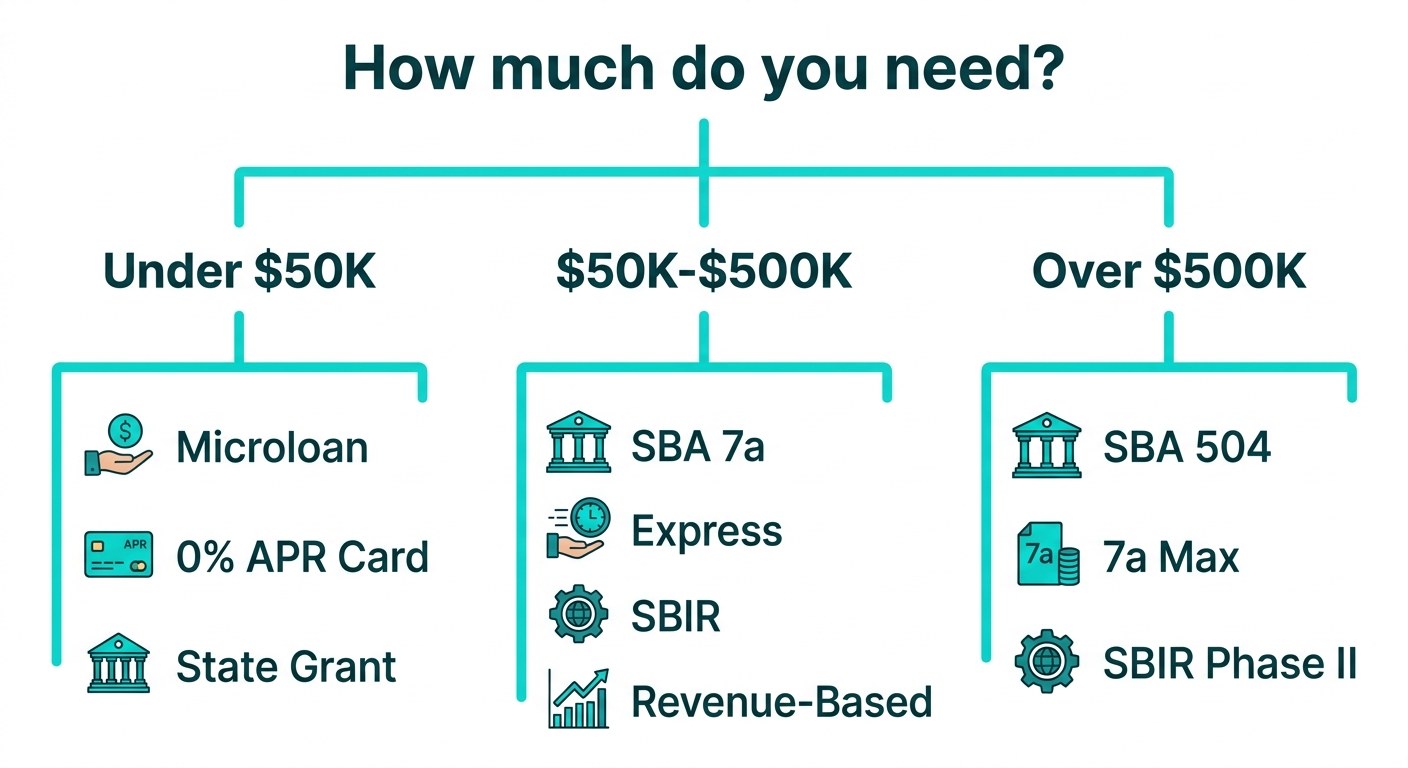
How much do you need?
Under $15,000:
- Good personal credit? Use a 0% intro APR business credit card
- Want to keep it simple? Ask your vendor about payment plans
- In a state with tech grants? Apply for free money first
$15,000 - $50,000:
- First time borrowing? SBA Microloan
- Need it fast? SBA Express
- Building something custom? Check SBIR eligibility
$50,000 - $150,000:
- Mix of SaaS and implementation? SBA 7(a)
- Mostly hardware/custom software? Consider SBA 504
- Strong monthly revenue? Revenue-based financing for speed
$150,000+:
- Major fixed assets? SBA 504 (lowest rates, lowest down payment)
- Mixed use? SBA 7(a)
- R&D component? SBIR/STTR grant + supplemental financing
Always, regardless of amount:
- Claim Section 179 on qualifying purchases
- Evaluate R&D tax credit eligibility for custom development
- Check state grant programs before borrowing
- Use our ROI calculator to project returns before applying
Stop Letting Cost Be the Excuse
The business owners who win in the next 5 years are the ones investing in AI and automation now.
The ones who lose are the ones who said "I can't afford it" while government grants went unclaimed, SBA loans went unapplied for, and tax credits went unused.
The money is available. The programs exist. The ROI is proven.
You just need to pick a path and start.
If you've read this far, you already know which option fits. Go apply.
And if you want help calculating the exact ROI for your specific business before you commit, we'll do it for free.
Ready to fund your AI investment?
We help small business owners calculate their automation ROI, choose the right financing path, and build implementation plans that satisfy lenders and grant committees.
Book a free system audit and we'll map out your best financing options in 30 minutes.
Ready to Automate Your Business?
Book a free strategy call and we'll map out exactly what to build first.
Book Your Call
Join the Conversation