

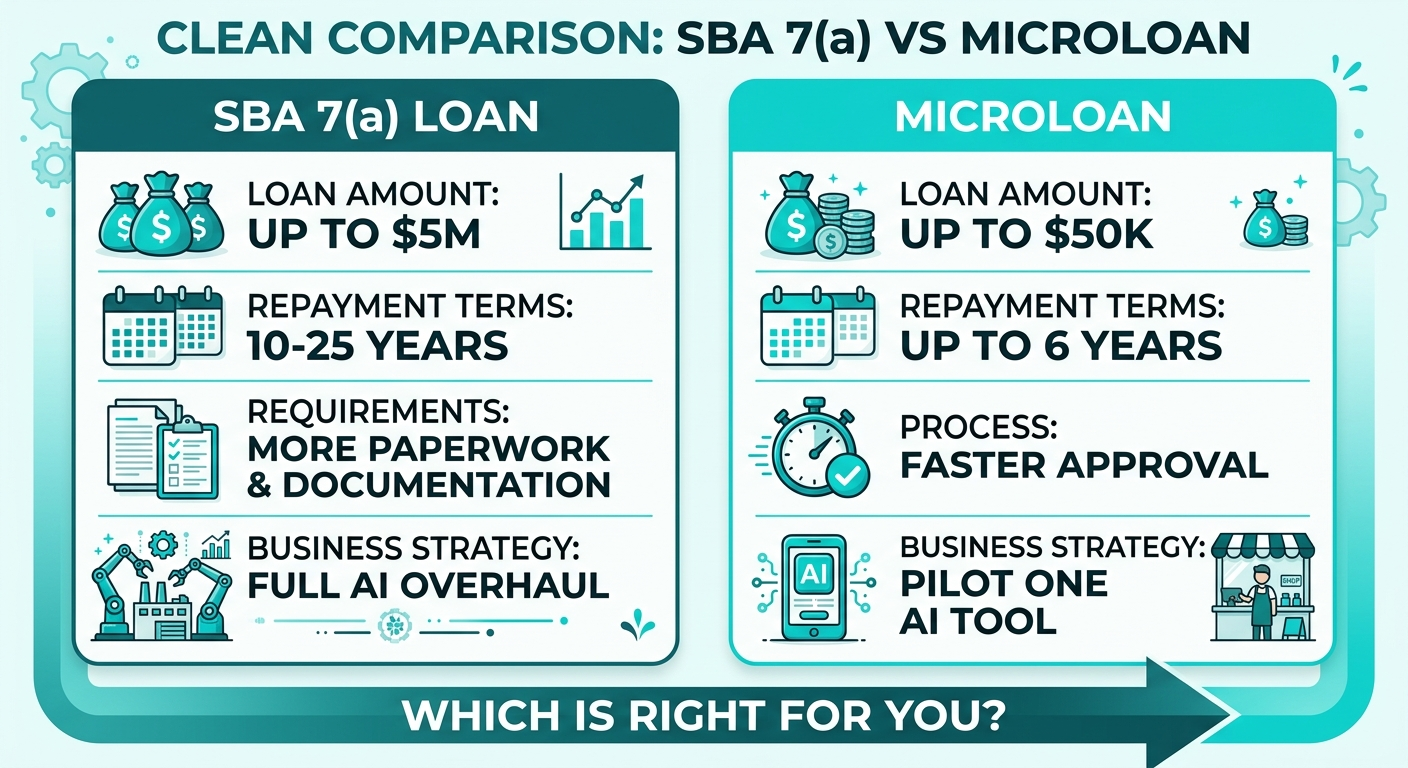
- SBA 7(a): Up to $5M, best for full-scale AI overhaul, requires more documentation
- Microloans: Up to $50K, faster approval, perfect for starting with one tool
- Your revenue, timeline, and automation goals determine which one wins
You've Decided to Fund AI. Now Pick the Right Loan.
Good. You're past the "should I invest in AI" stage. That question answered itself when your competitor started closing deals at 11 PM while you were asleep.
Now the question is how to pay for it.
The SBA gives you two main options for technology funding: the 7(a) loan and the microloan. They're not interchangeable. Picking the wrong one wastes time, costs money, and delays your automation by months.
This is the side-by-side breakdown. By the end, you'll know exactly which one to apply for.
If you need the full picture on SBA loans and AI funding, start with our complete SBA loan guide for AI automation. This post is the decision framework.
The Quick Comparison
| Feature | SBA 7(a) | SBA Microloan |
|---|---|---|
| Max amount | $5,000,000 | $50,000 |
| Interest rate | Prime + 2.25-4.75% | 8-13% |
| Max term | 10 years (tech/working capital) | 6 years |
| SBA guarantee | Up to 85% | 100% (to intermediary) |
| Approval time | 2-12 weeks | 1-4 weeks |
| Lender type | Banks, credit unions | Nonprofit intermediaries |
| Paperwork | Heavy | Moderate |
| Credit score | 680+ recommended | 620+ often accepted |
| Time in business | 2+ years preferred | 1+ year often sufficient |
| Collateral | Often required over $25K | Varies by lender |
| Best for | Complete AI transformation | First automation tool |
Same government backing. Completely different experiences.
SBA 7(a) Loan: The Full Rebuild
When It Makes Sense
You've mapped your processes. You know where the waste is. And the fix isn't one tool. It's a full stack.
CRM. Chatbot. Email automation. SMS sequences. AI-powered analytics. Custom integrations connecting everything. Training for your team. Maybe even a hire to manage it all.
That's a 7(a) play.
The 7(a) is built for businesses that need $50K+ in technology investment. The kind of overhaul where you walk in with manual processes and walk out with a machine that runs while you sleep.
What You'll Actually Spend It On
A typical 7(a)-funded AI buildout looks like this:
Phase 1 (Month 1-2): Foundation - $25,000-$60,000
- CRM platform setup and data migration
- Core automation workflows (lead capture, follow-up, booking)
- Staff training on new systems
- See our full services
Phase 2 (Month 3-4): Intelligence - $15,000-$40,000
- AI chatbot deployment
- Predictive analytics setup
- Custom API integrations
- Advanced reporting dashboards
Phase 3 (Month 5-6): Scale - $10,000-$30,000
- Marketing automation expansion
- AI-powered content generation
- Voice AI for phone handling
- Ongoing optimization and support
Total: $50,000-$130,000 over 6 months.
With a 7(a) loan at prime + 2.75% over 10 years, a $100,000 loan runs about $1,100/month. If your automation generates even $3,000/month in savings and new revenue (and it usually generates way more), you're cash-flow positive from month one.
The Application Process (Real Talk)
The 7(a) process is thorough. Not impossible. Just thorough.
You'll need:
- Business plan with technology investment section
- 3 years of tax returns (business and personal)
- Year-to-date financial statements
- Debt schedule
- Vendor quotes for all technology purchases
- ROI projections showing how the investment pays for itself
- Resume and background for all owners with 20%+ stake
The timeline: Expect 30-90 days from application to funding. Some Preferred Lenders move faster. SBA Express can get you a response in 36 hours, but caps at $500K with a lower guarantee.
Pro tip: Walk in with your ROI already calculated. Our ROI calculator helps build the numbers lenders want to see. Or book a free audit and we'll create the technology plan you can hand directly to your banker.
Who Gets Approved
The 7(a) favors established businesses. Not exclusively. But the numbers matter.
- 2+ years in business with documented revenue
- 680+ credit score (some lenders flex, most don't)
- Positive cash flow or clear path to it
- No recent bankruptcies or delinquencies
- Collateral for loans over $25K (not always required, but helps)
If that's you, the 7(a) is your best rate and longest terms. Period.
SBA Microloan: The Smart Start
When It Makes Sense
You don't need a $100K overhaul right now. You need one thing that works.
Maybe it's a CRM that actually follows up with your leads. Maybe it's a chatbot that catches the after-hours inquiries you're losing. Maybe it's an email automation system that nurtures prospects without you writing individual emails at midnight.
One tool. Implemented right. Generating returns fast.
That's the microloan play.
What $50K Actually Buys
More than you think.
Option A: CRM + Automation Starter ($15,000-$25,000)
- Full CRM setup with pipeline automation
- Automated lead follow-up sequences (email + SMS)
- Online booking integration
- Review request automation
- 12 months of platform costs
- Team training
Option B: AI Customer Service ($10,000-$20,000)
- AI chatbot for website and social media
- Knowledge base development
- Handoff protocols to human agents
- Integration with existing CRM
- 12 months of AI platform costs
Option C: Marketing Automation Engine ($20,000-$35,000)
- Email marketing platform setup
- Landing page development
- Lead scoring and segmentation
- Automated nurture sequences
- Social media scheduling
- Analytics and reporting
- 12 months of tool subscriptions
Option D: The Combo ($30,000-$50,000)
- CRM + chatbot + basic marketing automation
- The "I want all three but I'm not ready for enterprise" package
- Check our pricing page for exact numbers
The Application Process (Faster, Simpler)
Microloans go through nonprofit intermediary lenders, not banks. That changes the whole dynamic.
You'll need:
- Basic business plan (1-2 pages is often fine)
- 1-2 years of tax returns
- Bank statements (3-6 months)
- Brief description of how you'll use the funds
- Personal financial statement
The timeline: 1-4 weeks. Some intermediaries can fund in under 2 weeks.
Where to find microloan lenders:
- SBA Microloan Program page
- Your local Small Business Development Center (SBDC)
- Community Development Financial Institutions (CDFIs)
- Women's business centers (not just for women-owned businesses)
Who Gets Approved
Microloans are designed for businesses that banks overlook.
- 1+ year in business (some lenders work with startups)
- 620+ credit score (more flexible than 7(a))
- Lower revenue thresholds accepted
- Startups and newer businesses have a real shot
- No collateral required in many cases
- Owners with imperfect credit history can still qualify
If the 7(a) feels like a reach, the microloan might be your door in.
The Decision Framework
Stop guessing. Use this.
Go With SBA 7(a) If:
- Your monthly revenue is $30K+ and you have 2+ years of history
- You need $50K-$5M in technology investment
- You want the lowest possible interest rate and longest terms
- You're doing a complete automation overhaul (CRM + AI + marketing + integrations)
- You have a 680+ credit score and clean financial history
- You can wait 30-90 days for funding
- You want to bundle everything into one loan with one payment
Go With Microloan If:
- Your monthly revenue is $5K-$30K or you're in your first 2 years
- You need $5K-$50K for your first automation tool
- You want faster approval with less paperwork
- You're starting with one specific tool (CRM, chatbot, or email automation)
- Your credit score is 620-680 or you have limited credit history
- You need funding in under 4 weeks
- You want to prove ROI before scaling up with a larger loan later
The Hybrid Strategy (Smart Move)
Here's what the savviest business owners do.
Start with a microloan. Get $25K-$50K. Implement your CRM and basic automation. Run it for 6-12 months. Document the results. Revenue up. Costs down. Time saved.
Then apply for a 7(a). Now you walk in with proof. "I invested $35K in automation last year. Revenue increased 28%. Lead conversion doubled. Now I want $150K to scale what's working."
That loan officer is going to smile and hand you a pen.
Your microloan results become the business case for your 7(a) application. You're not asking them to believe projections. You're showing them receipts.
What About SBA Express?
Quick mention because it fits between the two.
SBA Express: Up to $500K, 36-hour SBA turnaround, 50% SBA guarantee.
It's the middle ground. Faster than a regular 7(a), bigger than a microloan, but with a lower guarantee that makes some banks pickier.
If you have strong credit (700+), solid revenue, and need $100K-$500K quickly, Express is worth exploring.
The Real Cost of Waiting
While you're deciding between loan types, your competitors are already automated.
Every month without automation:
- 22 hours of manual work your team does that software should handle
- 35% of after-hours leads that go to whoever responds first (not you)
- $3,200/month average in labor costs on tasks AI does for free
- Customer experience gap that gets wider every quarter
(McKinsey Global Institute estimates that 60-70% of employee time on routine tasks is automatable with current AI.)
The loan payment is temporary. The competitive advantage is permanent.
Pick Your Path. Then Move.
You've got the comparison. You've got the framework. You know which loan fits your situation.
Now execute.
Don't overthink this. The business owners who win aren't the ones who found the perfect loan. They're the ones who picked a loan, got funded, and started automating while everyone else was still reading articles about it.
If you want the numbers nailed down before you apply, here's the fastest path: we audit your current systems, identify the automation opportunities, estimate the ROI, and give you a technology investment plan you can hand directly to your lender.
No guessing. No wasted time. Just the plan and the numbers.
Book a free system audit and find out exactly what your AI stack should look like and what it'll cost.
Related reading:
Ready to Automate Your Business?
Book a free strategy call and we'll map out exactly what to build first.
Book Your Call
Join the Conversation