

- Up to $5.5 million in funding with only 10% down
- Qualifies: servers, hardware, major software implementations, equipment
- Doesn't qualify: SaaS subscriptions, working capital, inventory
- Interest rates are below market with 10-25 year terms
- Best for businesses making a $100K+ technology investment
The 504 Is the Loan Nobody Talks About
When small business owners think SBA loans, they think 7(a).
And the 7(a) is great. It's flexible. It covers a lot of use cases.
But if you're making a major technology investment - we're talking servers, infrastructure, equipment, a six-figure platform build - the 504 is the better loan. And almost nobody knows about it.
Here's why.
The SBA 504 loan was designed for major fixed asset purchases. Commercial real estate. Heavy equipment. Long-term infrastructure.
And in 2026, "long-term infrastructure" includes technology.
Servers. Data centers. Custom software platforms. Hardware for AI operations. Equipment that powers your business for the next decade.
The 504 offers lower down payments, below-market interest rates, and longer terms than almost any other financing option.
But there are strict rules about what qualifies. Let's break it down.
How the 504 Structure Works
This is the part that makes the 504 special.
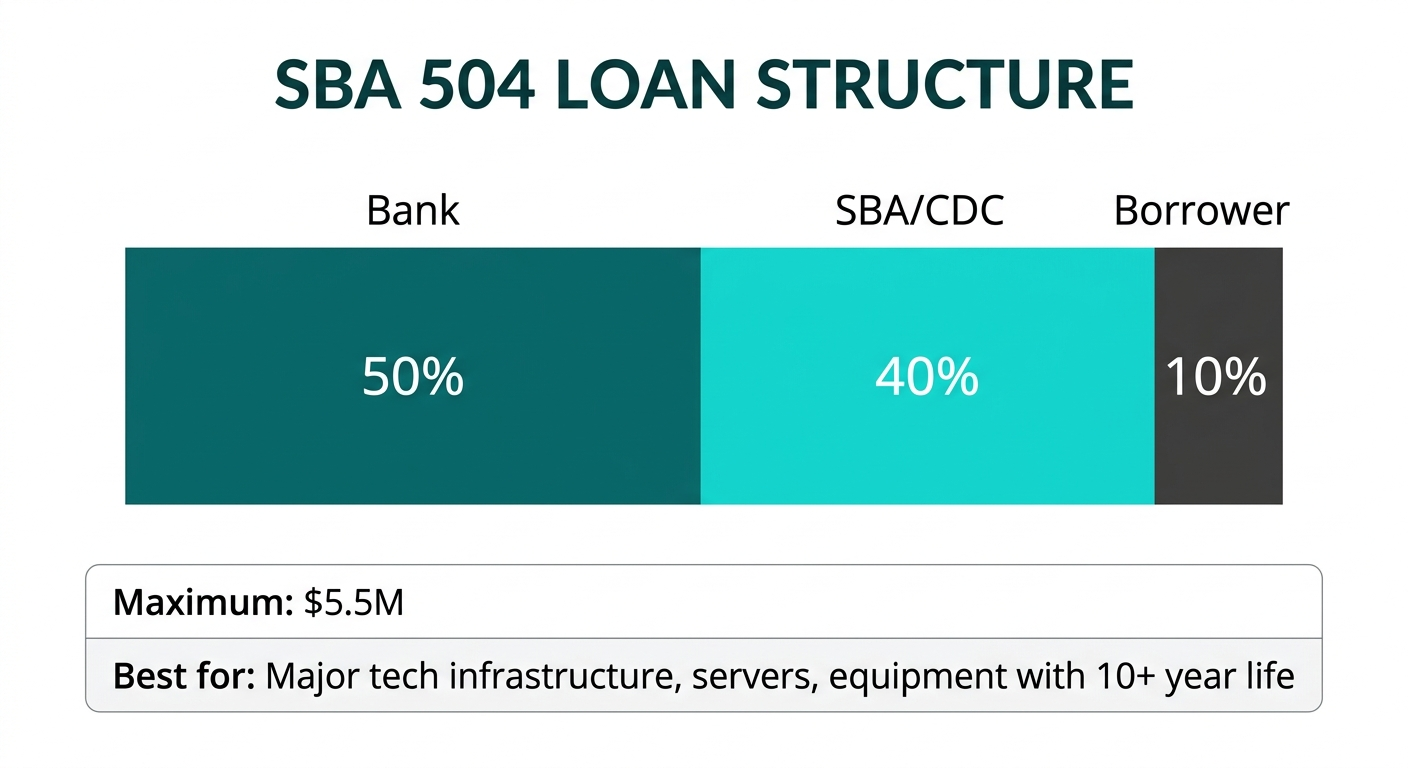
Most loans are simple: you borrow from a bank, you pay it back. The 504 splits the funding three ways:
| Source | Percentage | Details |
|---|---|---|
| Bank or lender | 50% | Standard commercial loan, first lien |
| CDC/SBA | 40% | Certified Development Company, backed by SBA debenture |
| Borrower | 10% | Your down payment |
CDC stands for Certified Development Company. These are nonprofit organizations certified by the SBA to provide 504 financing. There are about 270 CDCs across the country.
So on a $500,000 technology investment:
- Bank covers $250,000
- CDC/SBA covers $200,000
- You put down $50,000
Compare that to a conventional business loan where you'd need 20-30% down. That's $100,000-$150,000 out of pocket versus $50,000.
The CDC portion typically comes with a fixed interest rate pegged to Treasury rates. As of early 2026, that's running around 5.5-6.5% - well below what you'd get on a standard commercial loan.
Terms on the CDC portion are 10, 20, or 25 years depending on the asset type. Technology equipment typically falls under 10-year terms.
What Technology Qualifies for a 504 Loan
This is the critical question. The 504 is strict about what counts as a qualifying asset.
The rule is simple: it must be a long-lived, fixed asset.
Here's what qualifies:
Servers and Data Infrastructure
On-premises servers, networking equipment, data storage systems, and backup infrastructure. If you're building an AI operation that requires dedicated computing power, this is fundable.
Think: a company running proprietary AI models that need GPU clusters, a healthcare practice deploying on-site patient data systems for HIPAA compliance, or a manufacturing firm running AI quality control that needs edge computing hardware.
Major Software Implementations
Custom-built software platforms with a useful life of 10+ years. Enterprise software with perpetual licenses. Major ERP or operational systems.
The key word is perpetual or long-term. A one-time software purchase or custom development qualifies. A monthly SaaS subscription does not.
If you're building a custom application that will serve your business for a decade - a proprietary client portal, an AI-powered operations platform, a custom CRM built for your industry - that's a 504-eligible asset.
Technology Equipment
Industrial computers, specialized workstations, point-of-sale systems, diagnostic equipment with integrated AI, manufacturing robots, automated warehouse systems.
Any physical technology equipment that has a useful life matching the loan term qualifies.
Commercial Real Estate for Tech Operations
Building or renovating space specifically for technology operations. Server rooms. Tech-enabled office buildouts. Innovation labs. Training facilities with built-in technology infrastructure.
This is where 504 loans really shine. If you need to buy or renovate a building AND fill it with technology, you can bundle both into one 504 loan.
Renewable Energy and Smart Building Tech
Solar panels, smart HVAC systems, energy management AI, building automation systems. The SBA actively encourages green technology investments through the 504 program, and these can qualify for higher loan amounts (up to $5.5M vs. the standard $5M).
What Does NOT Qualify
This is where people get tripped up. The 504 has clear exclusions.
SaaS Subscriptions
Monthly or annual software subscriptions don't qualify. HubSpot, Salesforce, GoHighLevel, Slack, Zoom - none of these are 504-eligible because they're ongoing operating expenses, not fixed assets.
If your AI investment is primarily subscription-based, look at the SBA 7(a) loan instead. The 7(a) can fund working capital and recurring costs.
Working Capital
The 504 does not fund day-to-day operating expenses. Payroll, rent, marketing spend, consultant fees - these are all excluded.
Inventory
Physical or digital inventory is not a fixed asset under 504 rules.
Short-Lived Technology
Equipment or software with a useful life under the loan term doesn't qualify. If the technology will be obsolete in 3 years but the loan term is 10 years, that's a problem.
This is the gray area with technology. You need to make a credible case that your technology investment has a useful life that matches or exceeds the loan term. Custom-built platforms and enterprise hardware? Easy case. Consumer-grade laptops? Harder case.
Refinancing Existing Debt (Mostly)
The 504 has limited refinancing options. It's primarily for new purchases. If you already bought the technology and want to refinance, the 7(a) is usually the better option.
The Eligibility Requirements
Not every business can get a 504 loan. Here are the requirements:
Business size: Must be a for-profit business with a tangible net worth under $20 million and average net income under $6.5 million for the prior two years.
Job creation: The 504 program has job creation or retention requirements. Generally, you need to create or retain one job per $90,000 of SBA funding (or $130,000 for small manufacturers). Some exceptions apply for community development and energy goals.
Owner-occupied: For real estate, the business must occupy at least 51% of the space (60% for new construction).
Location: Must operate in the United States.
Good character: Principals must have no recent criminal history and must not be delinquent on government debt.
Most small businesses making a significant technology investment will meet these requirements. The net worth and income caps are generous enough to cover the vast majority of small and mid-sized businesses.
504 vs. 7(a) for Technology: Quick Comparison
| Feature | SBA 504 | SBA 7(a) |
|---|---|---|
| Max amount | $5-5.5M | $5M |
| Down payment | 10% | 10-20% |
| Interest rate | Fixed, below market (CDC portion) | Variable or fixed, market rate |
| Term | 10, 20, or 25 years | Up to 25 years |
| Best for | Major fixed assets, infrastructure | Working capital, mixed-use, SaaS |
| SaaS eligible | No | Yes |
| Working capital | No | Yes |
| Speed | 60-90 days | 30-60 days |
| Fees | CDC fees (~2.65% of debenture) | Guarantee fees (2-3.75%) |
Bottom line: If your technology investment is a major fixed asset (servers, custom software, equipment) over $100K, go 504. If it's a mix of subscriptions, implementation, and working capital, go 7(a).
For a deeper comparison of 7(a) and microloan options, read our SBA 7(a) vs. Microloan guide.
How to Apply for a 504 Technology Loan
Step 1: Find a CDC
You need a Certified Development Company in your area. The SBA maintains a directory of CDCs organized by state. Your CDC will be your primary partner throughout the process.
Step 2: Find a Participating Lender
The bank provides 50% of the financing. Many CDCs have established relationships with lenders and can help with this match. You can also use SBA Lender Match to find banks that participate in 504 programs.
Step 3: Prepare Your Application
You'll need:
- Full business plan with technology section (use our business plan framework)
- 3 years of business tax returns
- 3 years of personal tax returns for all owners with 20%+ stake
- Current financial statements (P&L, balance sheet)
- Technology vendor quotes and specifications
- Useful life documentation for the technology asset
- Job creation/retention projections
Step 4: Demonstrate Useful Life
This is the 504-specific requirement that trips people up. You need to show that your technology investment will have a useful life that justifies the loan term.
For custom software: provide documentation from your development partner on architecture, technology stack longevity, and maintenance/upgrade plans.
For hardware: provide manufacturer specifications on expected lifespan, warranty periods, and industry standard replacement cycles.
Step 5: Submit and Wait
504 loans take 60-90 days on average from application to funding. The CDC reviews your application, the bank underwrites their portion, and the SBA authorizes the debenture.
It's slower than a 7(a) or Express loan. But the interest rate savings and lower down payment more than make up for the wait.
When the 504 Makes Sense for AI Investment
The sweet spot for a 504 technology loan:
- You're investing $100,000+ in technology
- The investment includes physical equipment or custom-built software
- You want the lowest possible interest rate
- You want to put as little down as possible (10%)
- You're building infrastructure that will last 10+ years
- You can meet the job creation requirements
If you're a growing business that needs a technology consulting partner to help plan and execute a major technology build, the 504 is designed for exactly this scenario.
Real Numbers: What a 504 Technology Loan Looks Like
Let's say you're investing $400,000 in technology infrastructure:
Your cost breakdown:
- Custom AI operations platform: $180,000
- Server and networking hardware: $120,000
- Implementation and integration: $60,000
- Training and deployment: $40,000
504 loan structure:
- Bank portion (50%): $200,000 at 8.5% for 10 years = ~$2,480/month
- CDC/SBA portion (40%): $160,000 at 5.8% for 10 years = ~$1,760/month
- Your down payment (10%): $40,000
Total monthly payment: ~$4,240/month or ~$50,880/year
If the technology saves you $120,000/year in labor costs (which is conservative for a $400K investment), you're cash-flow positive from month one. Net savings after loan payment: $69,120/year.
After the 10-year term, the technology is paid off and you keep the full $120,000 annual savings. Plus whatever additional revenue the technology helped generate.
Stop Overpaying for Technology Financing
If you're considering a major technology investment and you're looking at conventional bank loans with 20% down and market-rate interest, stop.
Check 504 eligibility first. The lower down payment and below-market rates on the CDC portion can save you tens of thousands of dollars over the life of the loan.
And if your investment doesn't fit the 504 mold, you still have options. Check our complete guide to AI financing options for every alternative.
Planning a major technology investment?
We help businesses scope their AI and automation infrastructure, connect with CDCs and lenders, and build implementation plans that satisfy 504 requirements.
Book a free system audit and we'll help you figure out if the 504 is the right fit.
Ready to Automate Your Business?
Book a free strategy call and we'll map out exactly what to build first.
Book Your Call
Join the Conversation