

Most small businesses are still doing SEO the 2018 way.
Open Ahrefs. Pull a keyword list. Paste into a Google Doc. Write a brief. Hand it to a writer. Wait two weeks. Publish. Hope.
Meanwhile, the teams running AI agents for SEO are shipping the same article in 30 to 60 minutes (Graphed) and updating 50 pages a week without touching a CMS.
That's not a hype gap. That's a workflow gap.
The numbers behind it:
- 94% of marketers plan to integrate AI into content and blogging workflows this year (Loopex Digital)
- 30 to 50% average SEO work-time reduction once agents are deployed (Graphed)
- 75% of staff effort has shifted from production to strategy in agent-driven teams (Loopex Digital)
- 23% of organizations are already scaling agentic AI; another 39% are running pilots (McKinsey via Loopex Digital)
If you run a service business, this matters because SEO is one of the few channels where compounding actually exists. One ranked page brings you leads for years. The faster you can ship and refresh those pages, the bigger your moat gets.
Here's the order I'd build them in.
What "AI Agent for SEO" Actually Means
Before the playbook: an agent is not a prompt.
A prompt is "write me a meta description for this URL." An agent is "monitor my top 50 pages, flag any that drop more than 10 positions, draft a refresh, and queue it for my approval."
The difference is autonomy. Agents have a goal, tool access (your CMS, Search Console, an SEO API, your CRM), and memory of what worked last time. You set the rule. The agent runs the loop.
That's why the productivity numbers are so different from "I use ChatGPT for SEO." A chatbot saves you minutes. An agent gives back hours.
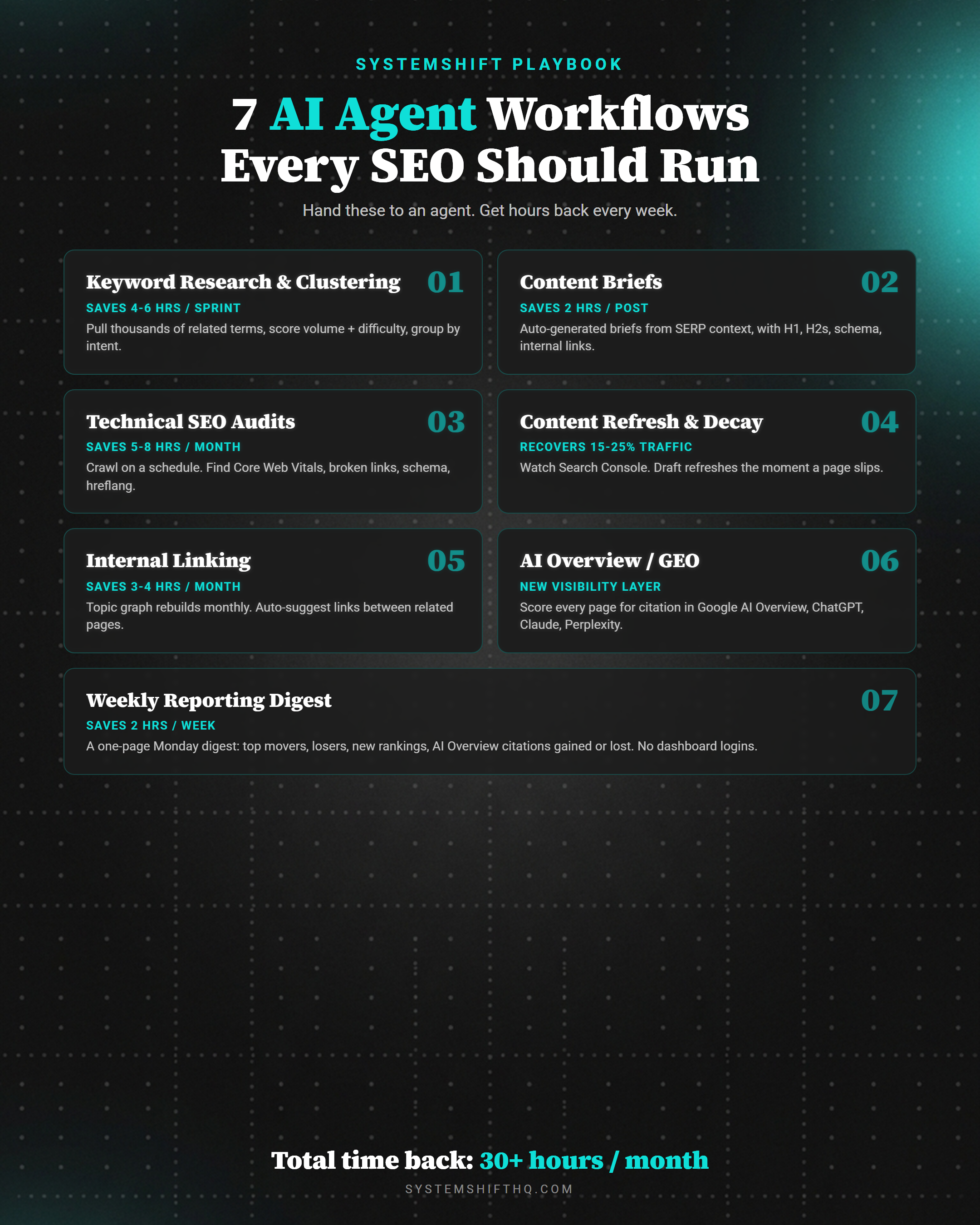
Workflow 1: Keyword Research and Clustering
What it does: You give the agent a topic. It pulls thousands of related keywords, classifies each one by search intent, scores difficulty and volume, groups them into clusters, and hands you a content map.
The old version was three hours in a spreadsheet. The agent does it before your coffee is cold.
Why it works: AI can map semantically related terms, predict ranking difficulty, and identify content gaps in a single pass (Graphed). Most small business sites have 10x the keyword opportunity they realize because nobody had time to map it.
Stack we use:
- A keyword API for the volume and difficulty data
- Claude or GPT-5 for intent classification and clustering
- Output dropped into a Google Sheet with cluster, primary keyword, supporting keywords, and recommended content type
Time back: 4 to 6 hours per content sprint.
Workflow 2: Content Briefs
What it does: For any keyword cluster, the agent pulls the top 10 ranking pages, extracts their structure, finds the questions they all answer, finds the questions none of them answer, and generates a brief with the H1, every H2, recommended word count, schema to include, and internal links to add.
A well-engineered prompt produces a publish-ready brief in seconds (Graphed). An agent runs that prompt across your entire content backlog overnight.
Why it works: The brief is where most posts get killed. A weak brief produces a weak post no matter who writes it. An agent that pulls SERP context every time guarantees the floor is competitive.
Time back: 2 hours per post. If you publish weekly, that's 8 hours a month before the writing even starts.
Workflow 3: Technical SEO Audits
What it does: The agent crawls your site on a schedule, finds Core Web Vitals issues, broken links, duplicate content, missing schema, broken canonicals, and hreflang errors. Then it logs each one to a ticketing system or directly drafts the fix.
In 2026, your site has over a dozen non-human visitors crawling it (opositive.io): GPTBot, ClaudeBot, PerplexityBot, Google-Agent, ChatGPT-User. Each one needs your technical foundation to be clean or you're invisible.
Why it works: Technical issues are exactly the kind of work agents were built for. Repetitive, rule-based, easy to verify. A weekly audit that used to take an SEO consultant 6 hours now runs in the background while you sleep.
Stack we use:
- A crawler API
- A Google Search Console pull for indexation data
- An agent that diffs this week's audit against last week's and flags only what changed
Time back: 5 to 8 hours a month for an active site.
Workflow 4: Content Refresh and Decay Detection
What it does: The agent monitors your top 50 pages in Search Console. When a page drops in position, loses impressions, or starts losing clicks, it flags the page, pulls the current top 3 ranking pages for that query, and drafts a refresh that closes the gap.
This is the workflow that quietly makes the biggest revenue difference. Most service business sites lose 20 to 40% of their organic traffic every year to content decay because nobody has time to refresh anything. An agent that watches every URL and draft-fixes the leaks is worth more than a new blog post.
Why it works: Pages not updated in 2+ years rarely get cited in Google's AI Overview, and freshness is one of the strongest ranking signals on informational queries.
Time back: Recovers 15 to 25% of lost organic traffic for most sites within 90 days.
Workflow 5: Internal Linking
What it does: The agent reads every page on your site, builds a topic graph, and recommends or auto-inserts internal links between related pages. New blog post goes live? The agent finds the 12 most contextually relevant existing pages and adds a link to the new post from each.
Why it works: Internal linking is the single most under-used ranking lever for small business sites. Your homepage authority is wasted if it doesn't flow to your money pages. Most owners do this by hand once and never touch it again.
An agent that re-runs the topic graph monthly compounds. New content automatically gets linked from old content. Old content gets fresh signals. Google notices.
Time back: 3 to 4 hours a month. ROI shows up in rankings 60 to 90 days out.
Workflow 6: AI Overview and GEO Optimization
What it does: The agent reads each of your pages, scores how well it's structured for citation in Google's AI Overview, ChatGPT, Claude, and Perplexity, and rewrites the parts that block you from being quoted.
This is GEO, generative engine optimization, and it's the new layer on top of traditional SEO.
Why it works: AI Overview now appears on roughly 60% of US searches, and 80% of cited sources don't even rank in the top 10 organically. The pages getting cited are the ones with semantic completeness, clean schema, and direct answers in the first 200 words. An agent can score every URL on your site against that rubric in minutes and queue rewrites for the failures.
Time back: This isn't really about hours saved. It's about being visible in a layer most competitors haven't optimized for yet.
Workflow 7: Reporting
What it does: Every Monday morning, the agent assembles a one-page report: this week's top movers, biggest losers, new keywords ranking, pages that gained or lost AI Overview citations, technical issues that opened or closed. No dashboard logins. No tab juggling.
Why it works: Most owners stop watching their SEO data because the dashboards are exhausting. An agent that delivers a digest you can read in 60 seconds means you actually act on the data.
Time back: 2 hours a week of "checking the numbers" that you mostly weren't doing anyway.
How This Stacks With the Rest of Your Agent Roster
If you've already read 3 AI agents every business owner can use, you'll notice the pattern.
Lead generation, follow-up, and client retention each get their own agent. SEO is the same. You don't run one giant SEO agent. You run a small roster, each one owning a slice.
In our stack, the SEO roster connects to the rest:
- The keyword agent feeds the content brief agent
- The content brief agent feeds Scribe, our writing agent
- The technical audit agent flags issues to our DevOps agent
- The reporting agent posts to the same Friday digest as our client health agent
That's the unlock. Agents that pass work to each other. Not a chatbot you have to babysit.
Where Most Owners Get This Wrong
Three traps I see weekly.
Trap 1: Buying an "all-in-one AI SEO tool" expecting it to be an agent. Most of them are still chatbots in a wrapper. If it can't run on a schedule and act without you, it's not an agent. Ask whether it has tool access to your CMS and your Search Console. If the answer is no, keep moving.
Trap 2: Letting the agent publish without a human review step. Even the best agents drift. Every workflow above should end with "queue for approval," not "auto-publish." Set a 5-minute daily review window. That's all it takes.
Trap 3: Skipping the brief. The temptation with agents is to skip the brief and have the agent write the post directly from the keyword. The output is generic and reads like every other AI blog. Always brief, always pull SERP context, always include your real examples and data.
What To Do This Week
You don't need all 7 workflows running by Friday.
Pick the one that maps to the leak you have right now:
- No new content shipping? Start with Workflow 2 (briefs).
- Site has technical issues you've ignored? Start with Workflow 3 (audits).
- Old posts losing traffic? Start with Workflow 4 (refresh).
- You don't even know what's ranking? Start with Workflow 7 (reporting).
Build one. Let it run for two weeks. Measure the time it gives back.
The 30 to 50% productivity gains in the data don't come from the smartest agent. They come from the boring one that runs every week without forgetting.
That's the system.
-Rock
Frequently Asked Questions
What is an AI agent for SEO?
An AI agent for SEO is software that runs on a goal, not a prompt. You give it a target (find decaying pages, audit the site, draft a brief), and it uses tool access to your CMS, Search Console, and an SEO API to plan, execute, and report back without you babysitting it. Unlike a chatbot, it operates on a schedule and remembers what worked last time.
How much time do AI agents save on SEO?
Across published case data, agentic workflows cut SEO work time 30 to 50% and shrink content production from 9 to 14 hours per post down to 30 to 60 minutes (Graphed). Most service businesses get 30+ hours back per month once 4 or 5 workflows are running.
Are AI agents for SEO better than tools like Surfer or Ahrefs?
They are not a replacement, they are a layer on top. Tools like Ahrefs, Semrush, and Surfer provide the data. Agents use that data on a schedule and act on it, drafting refreshes, queueing internal links, building briefs. Most production stacks combine both.
Will AI agents replace SEO experts?
No. They replace the routine work like keyword pulls, technical audits, content briefs, performance reporting. Strategy decisions like what to target, how to position, when to pivot, still need a human. The agents free up the strategist to actually strategize (Loopex Digital).
Where should a small business start?
Pick the leak. If you publish irregularly, start with content briefs. If old posts are losing rankings, start with content refresh. If you do not even know what is ranking, start with the weekly reporting digest. Build one workflow, run it for two weeks, measure the time it gives back, then build the next.
Want help mapping which SEO workflow to agent-ify first? Book a 15-minute audit at systemshifthq.com/book and we'll show you the highest-ROI agent for your site.
Ready to Automate Your Business?
Book a free strategy call and we'll map out exactly what to build first.
Book Your Call
Join the Conversation