

Everyone's talking about AI agents. Almost nobody is running one.
Gartner projects that by the end of this year, 40% of small and mid-size businesses will have at least one AI agent deployed (Gartner via WhiteBeard Strategies). The 2026 Intuit and ICIC report puts AI adoption at 89% of small businesses already (ColorWhistle). Salesforce found 91% of SMBs using AI say it boosts revenue (OneReach).
The gap isn't interest.
The gap is knowing which agents to build first.
Here's the thing no one tells you. You don't need 20 agents. You need 3. One that fills the top of your pipeline. One that keeps warm leads moving. One that keeps the clients you already closed from churning.
These are the three we run inside SystemShift. Same architecture any business owner can copy.
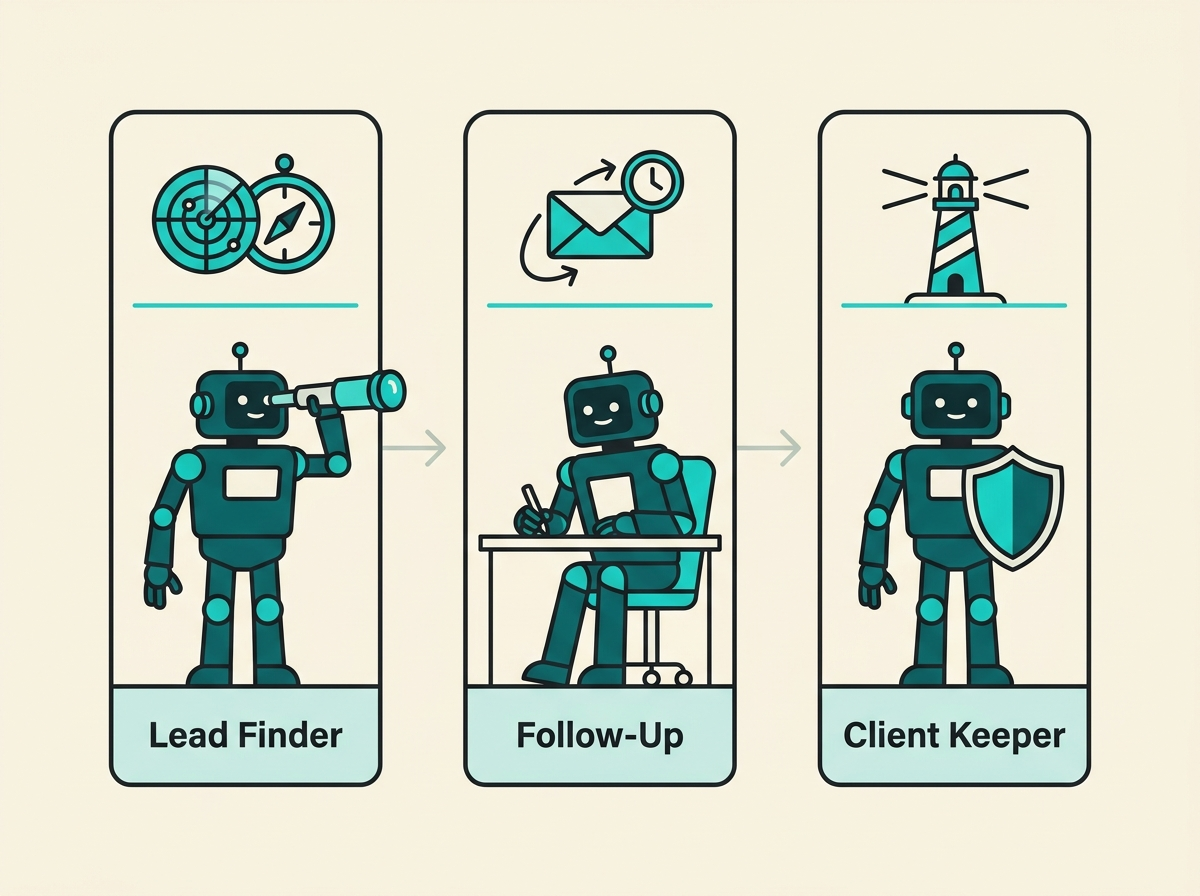
Agent 1: The Lead Finder (Meet Radar)
What it does: Radar is an outbound lead generation agent. It hunts businesses that match your ideal customer profile, scores them against a fit rubric, and drops the qualified ones into your CRM with context already attached.
Not a list you bought off Apollo. Not a cold spreadsheet.
Qualified leads, pre-researched, with a reason they're worth your time.
How Radar actually works in our stack
Radar runs a real Chrome session (no headless bot) and pulls from live sources: Google Maps, Yelp, BBB, LinkedIn public profiles, industry directories. For each business it finds, it grabs the company name, phone, website, owner or decision-maker if public, review count, and any tech signals that show automation readiness.
Then it scores each lead 0 to 100 against our ICP and pushes the passing ones straight to the "LI - Fitness and Personal Trainers" campaign in Instantly, skipping anything without a verified email.
Output: a new batch of qualified, ICP-matched leads in the CRM every morning.
Why this matters for your business
AI lead scoring boosts conversion rates 25 to 215% according to 2026 sales automation benchmarks (Salesmate). Reps using AI tools are 3.7x more likely to hit quota. And teams using AI sales stacks see 43% higher win rates.
Translation: an agent that does discovery, qualification, and enrichment for you doesn't just save time. It changes the math on who you close.
A home services owner can have Radar pull every competitor's Google Business Profile reviewers, cross-check for businesses in a 20-mile radius, and drop a daily prospect list into GoHighLevel. Before the owner has finished breakfast.
What a non-technical version looks like
You don't need to build Radar from scratch. The pattern is reusable:
- Pick one source (Google Maps works)
- Define 3 ICP filters (industry, location, size)
- Have the agent rank fit and push the top 10 daily to your CRM
- Never manually prospect again
Agent 2: The Follow-Up Machine (Meet Nurture)
What it does: Nurture reads engagement data from every newsletter subscriber and auto-drafts a personalized follow-up for the ones who are reading but haven't booked a call.
Most leads don't die because the pitch was wrong.
They die because nobody followed up.
How Nurture actually works in our stack
Every morning at 9am EST, an engagement scanner tags subscribers in GoHighLevel based on email opens and clicks: newsletter-hot if they opened 4 of the last 5, newsletter-warm if they opened 2 of 5.
One hour later, Nurture wakes up and reads those tags. For every warm or hot subscriber who hasn't booked a call or been nurtured in the last 14 days, it pulls their engagement score, opens, clicks, and any notes on their contact profile, then drafts a personalized email referencing the specific content they read.
Rock reviews the drafts in a single GoHighLevel folder, edits what needs editing, and sends. What used to be 2 hours of writing a week is now 10 minutes of editing.
Output: 5 to 15 personalized follow-up emails a day, already written, already matched to the right subscriber.
Why this matters for your business
Small teams using AI for follow-ups save 40+ hours monthly (Salesmate). And the sales cycle shrinks 25 to 37% when follow-up is automated instead of forgotten.
The "follow-up graveyard" is the biggest silent killer in small business. Every lead that went cold because you got busy represents a close that almost happened.
An agent like Nurture doesn't replace your judgment. It just makes sure the first draft always exists.
What a non-technical version looks like
- Tag leads based on behavior (opened email, clicked link, visited pricing page)
- Have an agent draft a personalized follow-up for anyone tagged hot/warm who hasn't been contacted in 14 days
- Review, edit, send
Agent 3: The Client Keeper (Meet Beacon)
What it does: Beacon is a client success agent. It monitors your support inbox, builds a profile for every client, and gives you instant context before you reply to anyone.
Churn usually isn't a surprise.
It's a signal you missed.
How Beacon actually works in our stack
Beacon pulls emails from [email protected] every few minutes. For every inbound message, it identifies the sender, matches them to their client profile in our database, extracts any new context (questions, complaints, doc attachments, shared Google Drive links), and updates their profile.
Then it sends a personalized auto-acknowledgment written by Claude that references the client's history, not a generic "we got your email" template. Attachments save to the client's documents folder automatically. Questions that mention GoHighLevel get flagged to Sable, our GHL knowledge agent, so Rock has expert context before replying.
Every Friday, Beacon produces a client health digest: who's engaged, who's gone quiet, who has an unresolved question older than 48 hours, and who hasn't heard from us in 30+ days.
Output: every client interaction is context-rich, and nobody falls through the cracks.
Why this matters for your business
Customer service is the leading AI agent use case for small teams, according to 2026 adoption data. The reason is simple: high ticket volume, predictable intent, measurable KPIs. Agents like Beacon save 40+ hours a month on triage alone, and the prevention of a single churn event usually pays for the agent for a year.
The real unlock isn't speed. It's that every client feels seen. Nobody gets a generic reply. Nobody gets forgotten.
What a non-technical version looks like
- One shared inbox for clients
- An agent that reads every email and builds a rolling client profile
- Weekly health report that flags anyone who's gone dark
The Pattern: Top, Middle, Bottom of the Funnel
Notice what these 3 agents have in common.
Radar owns the top. It finds people who should be in the funnel.
Nurture owns the middle. It keeps warm leads moving toward a call.
Beacon owns the bottom. It keeps the people you already closed happy.
You don't need a swarm of agents. You need one for each stage.
Miss the top: your pipeline dries up.
Miss the middle: leads go cold.
Miss the bottom: clients churn and you rebuild from zero every quarter.
This is what most small businesses get wrong. They buy an AI tool for "productivity" and get better at one random thing. The fix is to think in stages: discover, nurture, retain.
What To Do This Week
You don't build all three at once.
Pick the stage that's leaking the worst right now.
If your calendar is empty: start with Radar.
If your leads are warm but not closing: start with Nurture.
If clients keep ghosting at renewal: start with Beacon.
Build one. Let it run for two weeks. Measure the time it gives back.
Then build the next.
That's how 40% of small businesses will get to "has an AI agent" by the end of this year. Not a launch. A system.
Want help figuring out which agent goes first? Book a 15-minute agent audit at systemshifthq.com/book and we'll map your funnel, find the biggest leak, and show you which agent plugs it.
Ready to Automate Your Business?
Book a free strategy call and we'll map out exactly what to build first.
Book Your Call
Join the Conversation