

Google changed the game. Again.
That answer box at the top of search results — the one that summarizes everything before anyone scrolls? That's Google's AI Overview. And it now shows up on 60% of all searches.
Here's the part that matters: if your website is cited in that box, you get 35% more clicks. If you're not cited, your click-through rate drops 61%.
Same search. Same page. Completely different outcome based on whether Google's AI decides to quote you.
The good news? 80% of sources cited in AI Overviews don't even rank in the top 10 for that query. Meaning a small service business can get featured without outranking the big players.
Here's how.
What Is Google's AI Overview and Why Should You Care?
AI Overview is the AI-generated answer that appears above traditional search results. Google pulls from multiple sources, synthesizes an answer, and links back to the pages it used.
When someone searches "how to fix slow follow-up in my business," Google's AI reads dozens of pages, picks the best answers, and credits the sources. If your content answers that question clearly and completely, you get cited.
The numbers tell the story:
- 60% of US searches now trigger AI Overview (up from 30% six months ago)
- 99.2% of AI Overviews appear on informational queries — the "how to" and "why does" searches
- Questions with 8+ words are 7x more likely to trigger an AI answer
- Being cited means 35% more organic clicks to your site
This isn't a future trend. It's happening on every search your customers make today.
How Google Picks Which Websites to Feature
Google doesn't just grab the #1 result. It evaluates content differently for AI Overview than for traditional rankings. Here's what it actually looks for.
Semantic Completeness
Pages scoring high on semantic completeness are 4.2x more likely to be cited. This means your content doesn't just answer the question — it anticipates the next three questions the reader would have.
If someone asks "how do I automate my follow-up process," your page should also cover:
- Why manual follow-up fails
- What tools to use
- How long setup takes
- What results to expect
One complete page beats five thin ones.
E-E-A-T Signals
Experience, Expertise, Authority, Trust. In 2025, Google made this an active filter — content without clear E-E-A-T signals gets filtered out before it's even considered for AI Overview.
What this means for your site:
- Named author with credentials — "Written by Rock Hunt, automation specialist with 10+ years in business systems"
- Publish and update dates visible — shows freshness
- Real examples and data — cite your sources, link to studies
- Trust signals — about page, business address, customer reviews
96% of AI Overview content has verified E-E-A-T signals. If yours doesn't, you're invisible.
Structured Data (Schema Markup)
This is the technical piece most small businesses skip. And it's the easiest win.
Schema markup tells Google exactly what your content is — an article, a FAQ, a how-to guide. Pages with proper schema show an 89% correlation with AI Overview selection.
Three types to add to every page:
Article Schema — tells Google this is a blog post with an author, publish date, and topic.
FAQ Schema — if your page answers 3+ questions, wrap them in FAQ markup. This alone increases your AI Overview appearance by 40% for pages already ranking in the top 10.
HowTo Schema — for any step-by-step guide. Google can pull your exact steps into the AI answer.
You don't need a developer for this. It's a block of code (JSON-LD) that goes in your page's tag. Google has a free testing tool to verify it works.
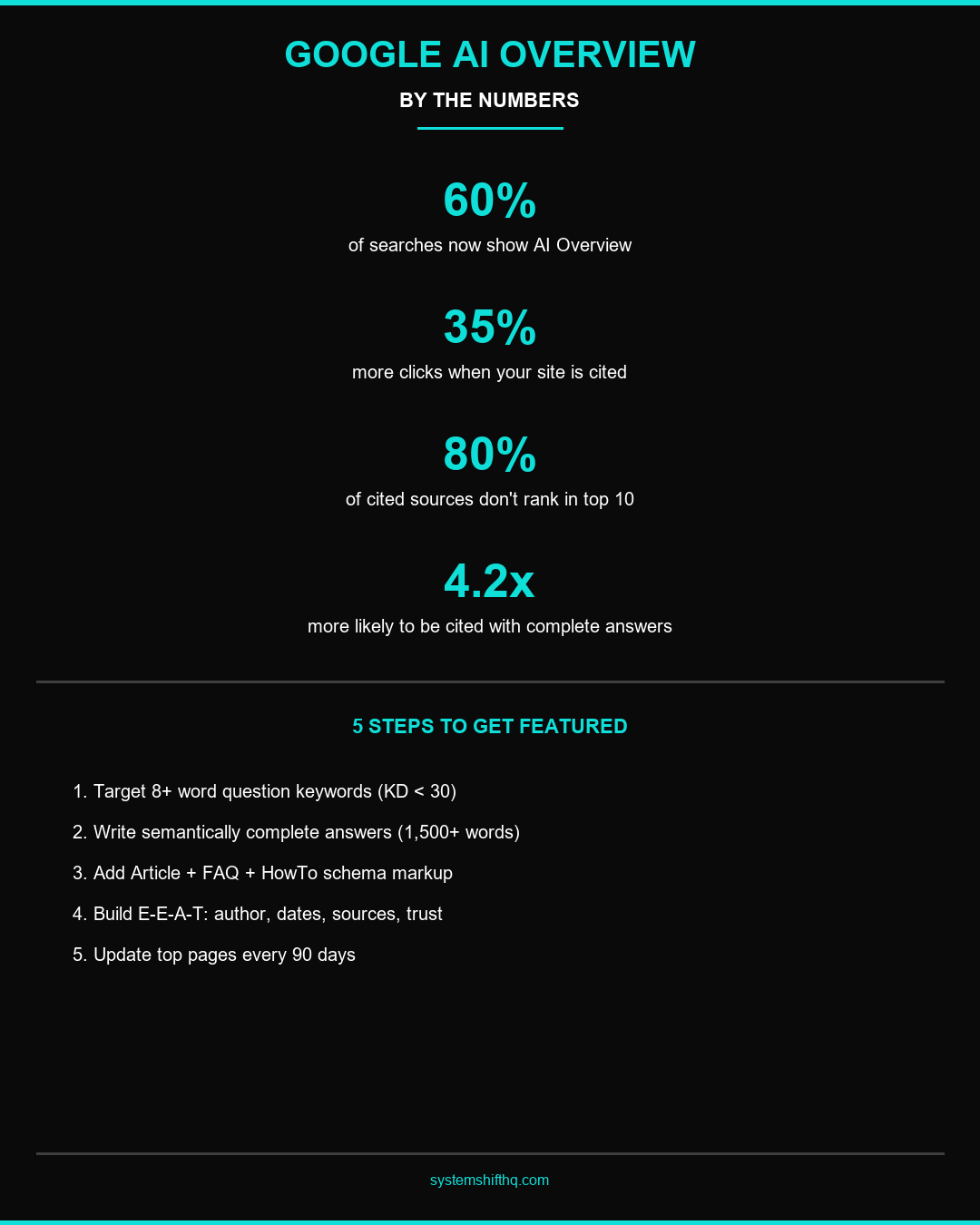
The 5-Step Framework to Get Featured
Step 1: Target the Right Keywords
AI Overview favors long-tail, question-based queries. Not "CRM software" — but "how to set up automated follow-ups in a CRM for a plumbing business."
Rules:
- 8+ words in the query (7x more likely to trigger AI Overview)
- Informational intent — how, why, what, best, vs.
- Keyword difficulty under 30 — you can actually rank for these
- Search volume 50-500/month — big enough to matter, small enough to win
Step 2: Write Semantically Complete Content
Answer the main question in your first 200 words. Then spend the rest of the article answering every related question someone might have.
Structure it like this:
- H1: The main question (8+ words)
- Quick answer: 2-3 sentences with the direct answer
- H2s: Each follow-up question as a header
- Under each H2: 2-3 sentence answer, then expanded explanation
- Lists and tables for comparisons and steps
- FAQ section at the bottom with 5-7 common questions
Target 1,500-2,500 words for competitive topics. 800-1,200 for niche keywords.
Step 3: Add Schema Markup
Before publishing any page, add these three schema types as JSON-LD:
- Article schema — headline, author name and credentials, publish date, modified date, image
- FAQ schema — every Q&A pair on the page
- HowTo schema — every step-by-step process
Test with Google's Rich Results Test before going live.
Step 4: Build E-E-A-T Into Every Page
- Author byline with credentials above the content
- Visible publish and update dates
- Link to sources for every major claim
- About page with photo, bio, certifications
- Customer reviews and case study links
- Physical business address and contact info
Step 5: Maintain and Update
Google prioritizes fresh content. Set a reminder to update your top-performing pages every 90 days:
- Add new stats and examples
- Update the "modified date"
- Answer new questions from Google's "People Also Ask" box
- Remove outdated information
What NOT to Do
These will get you filtered out of AI Overview consideration:
Don't write sales copy disguised as content. If 60%+ of your page is promotional, Google skips it. Lead with education. Mention your service naturally — 10-15% of the content, max.
Don't make claims without sources. "Studies show" with no link to the study? Google's AI catches that. Cite everything.
Don't publish without an author. Anonymous content fails the E-E-A-T filter. Put a name and credentials on it.
Don't keyword stuff. Writing "best CRM for plumbers" fifteen times in one article triggers content quality filters. Write for humans.
Don't let content go stale. Pages not updated in 2+ years rarely get cited. Even a small refresh with updated stats and a new date helps.
Don't ignore mobile. Google's AI crawls mobile-first. If your page loads slow or breaks on phones, it won't be considered. Target under 2.5 seconds load time.
The Bottom Line
AI Overview isn't replacing SEO. It's adding a new layer on top.
The businesses that get cited aren't the ones with the most backlinks or the biggest ad budgets. They're the ones that answer questions completely, structure their content clearly, and prove they know what they're talking about.
You don't need to be a massive authority to get featured. You need to be the most helpful, most complete, most trustworthy answer to a specific question.
Pick one question your customers ask every week. Write the best answer on the internet. Add the schema. Show your credentials. Update it quarterly.
That's the system.
-Rock
Ready to Automate Your Business?
Book a free strategy call and we'll map out exactly what to build first.
Book Your Call
Join the Conversation