

Will AI replace real estate agents?
About 390 people type that exact question into Google every month, and the number keeps climbing. I'd bet a lot of them are agents, searching late at night after one more headline about a robot that writes listing descriptions.
I get it. You watched ChatGPT write an offer summary in nine seconds, and a little voice said, "Well, that's it for me."
It isn't, and I don't mean that as a pep talk. The data says so, the buyers say so, and the job itself says so. Below is the exact reason why, plus the part of your job AI really will take, and what to do about it this week.
Will AI replace real estate agents? The short answer is no
Here's the thing.
Buyers have had Zillow, Redfin, and Realtor.com for almost 20 years. Every listing, every photo, every price history, free, on their phone. If information alone could replace agents, it would have happened already.
Instead, the opposite happened.
According to NAR's 2025 Profile of Home Buyers and Sellers:
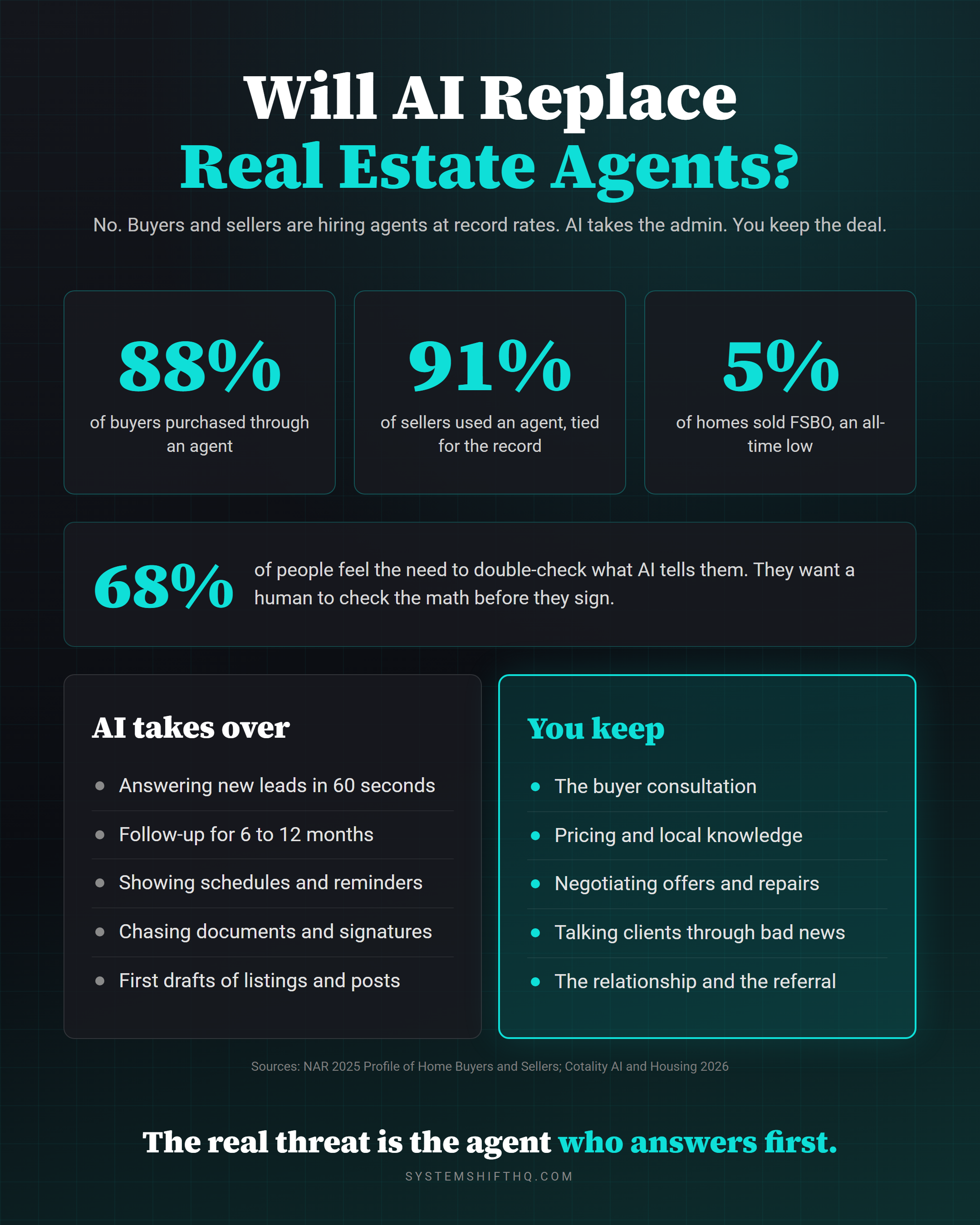
- 88% of buyers purchased their home through an agent or broker.
- 91% of sellers used an agent, tied for the highest share on record.
- FSBO sales dropped to 5%, an all-time low.
- FSBO homes sold for a median of $360,000, compared to $425,000 for agent-assisted homes.
That means sellers who went it alone sold for $65,000 less at the median.
More technology did not shrink the agent's role. It made buyers more informed and more overwhelmed at the same time. Overwhelmed people hire guides.
Why AI won't replace real estate agents: 4 reasons
AI is great at information. Real estate is not an information business. It's a judgment, trust, and negotiation business that happens to involve a lot of information.
Here's the breakdown.
1. People don't trust AI with the biggest purchase of their life
Consumers are using AI. They are not handing it the keys.
A June 2026 Veterans United Home Loans survey of 400 prospective buyers found 53% said they'd be comfortable buying a home without direct human involvement. Sounds scary, until you look closer: only 25% said they were "very comfortable." The rest are hedging.
And Cotality's AI and Housing 2026 research found 68% of people feel the need to double-check AI-provided information. Even more telling, 44% of consumers will pay a fee for a human to verify AI outputs.
So people will use AI to shop, but they want a person to check the math before they sign a 30-year loan. That person is you.
2. The hard part of the deal was never finding the house
Finding listings is easy now. Getting a deal to the closing table is not.
NAR's 2025 Profile found 76% of first-time buyers credited their agent with helping them understand the process, and more than half of buyers valued their agent pointing out features or flaws they hadn't noticed.
Think about what actually blows up deals:
- An inspection report with 40 items and a buyer ready to walk.
- An appraisal that comes in $20,000 short.
- A seller who's emotional about leaving the house their kids grew up in.
- A lender who goes quiet four days before closing.
AI can summarize an inspection report. It can't sit across from a nervous buyer, read the room, and talk them through which three items actually matter. It can't call the listing agent and work out a repair credit that saves the deal.
That work is the job, and it's the part clients pay for.
3. AI can't hold a license or carry the liability
Every transaction comes with legal duties, disclosures, fair housing rules, and real consequences when something goes wrong.
AI can't hold a real estate license. It can't sign as the responsible party. It can't be held accountable by a state commission, and it won't show up at mediation when a deal goes sideways.
Someone has to own the outcome. Clients want that someone to be a licensed human with a name, a phone number, and a reputation on the line.
4. Real estate runs on relationships, and AI doesn't have any
Your business doesn't come from strangers. It comes from your sphere, past clients, and referrals.
AI can't remember that your past client's daughter just started kindergarten. It can't text a neighbor congratulations on the new puppy. It can't earn the "you have to call my agent" referral at a backyard cookout.
AI can help you do those things on schedule. It can't be the person they trust.
So what will AI replace?
AI won't replace you. AI will replace the admin work that eats your day. The stuff you never got into real estate to do.
| AI will take over | You still own |
|---|---|
| Answering a new lead in under a minute, at 10pm | The buyer consultation |
| Follow-up texts and emails for 6 to 12 months | Reading what a client actually wants |
| Scheduling showings and reminders | Negotiating the offer and repairs |
| Chasing documents and signatures | Talking a client through a bad inspection |
| First drafts of listing descriptions and posts | Pricing strategy and local knowledge |
| Transaction milestone updates | The relationship and the referral |
Look at the left column. That's the work that falls through the cracks when you're busy, at a showing, or at your kid's game.
And it's costing you. Most agents don't lose deals because they're bad at real estate. They lose deals because the lead came in during a showing, and by the callback the buyer had already picked someone else.
The real threat: the agent who uses AI
So if AI isn't coming for your job, who is?
The agent who answers in 60 seconds while you answer in 6 hours.
According to NAR's 2025 Technology Survey, 32% of Realtors still don't use AI at all. And of the ones who do, 46% said it had no noticeable impact on their business.
Most agents use AI for typing: a listing description here, a caption there. That saves a few minutes, but it doesn't bring in a single extra deal.
The agents pulling ahead use AI for the work that makes money: speed to lead, follow-up that never stops, and a sphere that hears from them every month without them remembering to do it.
Picture two agents in the same market with the same skills. One has AI answering every lead at 10pm and checking in with every past client on schedule. The other is still writing follow-ups on sticky notes.
Guess who gets the next referral.
What to do this week
You don't need a 40-tool stack. Start with the one job that loses you the most money.
- Time your lead response. Fill out a form on your own website tonight. Time how long it takes for anyone to reply. If it's more than 5 minutes, start here.
- Set up one AI follow-up sequence. New leads get a reply in under a minute and a follow-up plan that runs for months, not days.
- Put your sphere on a schedule. A monthly touch to past clients, written in your voice, sent automatically. You just review and approve.
- Use ChatGPT or Claude for first drafts only. Listings, emails, posts. You edit. You never send AI copy raw to a client.
- Keep the human moments human. Consultations, negotiations, bad news. Those are yours.
Want the full breakdown of which tools do what? Read AI tools for real estate agents: the 6-job stack and 8 ways AI for real estate agents actually works. If you'd rather see what we build for agents and teams, start at AI for real estate.
FAQ
Will AI replace real estate agents?
No. According to NAR's 2025 Profile of Home Buyers and Sellers, 88% of buyers and 91% of sellers used an agent, and FSBO sales fell to an all-time low of 5%. AI will automate admin work like lead response, follow-up, and scheduling, but buyers and sellers still want a licensed human for negotiation, pricing, and the final decisions.
Will AI replace realtors in the next 10 years?
Unlikely. Online listings have been free for nearly 20 years, and agent usage went up, not down. Consumers use AI for research, but Cotality's 2026 research found 68% feel they need to double-check AI information, and 44% would pay for a human to verify it. Expect fewer agents doing admin by hand, not fewer agents.
How should real estate agents use AI?
Use AI for the repeatable work: answering new leads in under a minute, long-term follow-up, sphere check-ins, scheduling, and first drafts of listings and posts. Keep consultations, negotiations, pricing, and hard conversations human. Always review AI copy before it goes to a client.
Bottom line
AI is going to take the to-do list off your plate, and that's good news. The admin is the part that burns you out and lets leads slip.
Hand AI the follow-up, the scheduling, and the first drafts. Keep the trust, the negotiation, and the relationships.
If you want that follow-up system built for you, so every new lead gets a reply in under a minute and every past client hears from you once a month, grab a time with me.
Ready to Automate Your Business?
Book a free strategy call and we'll map out exactly what to build first.
Book Your Call
Join the Conversation