
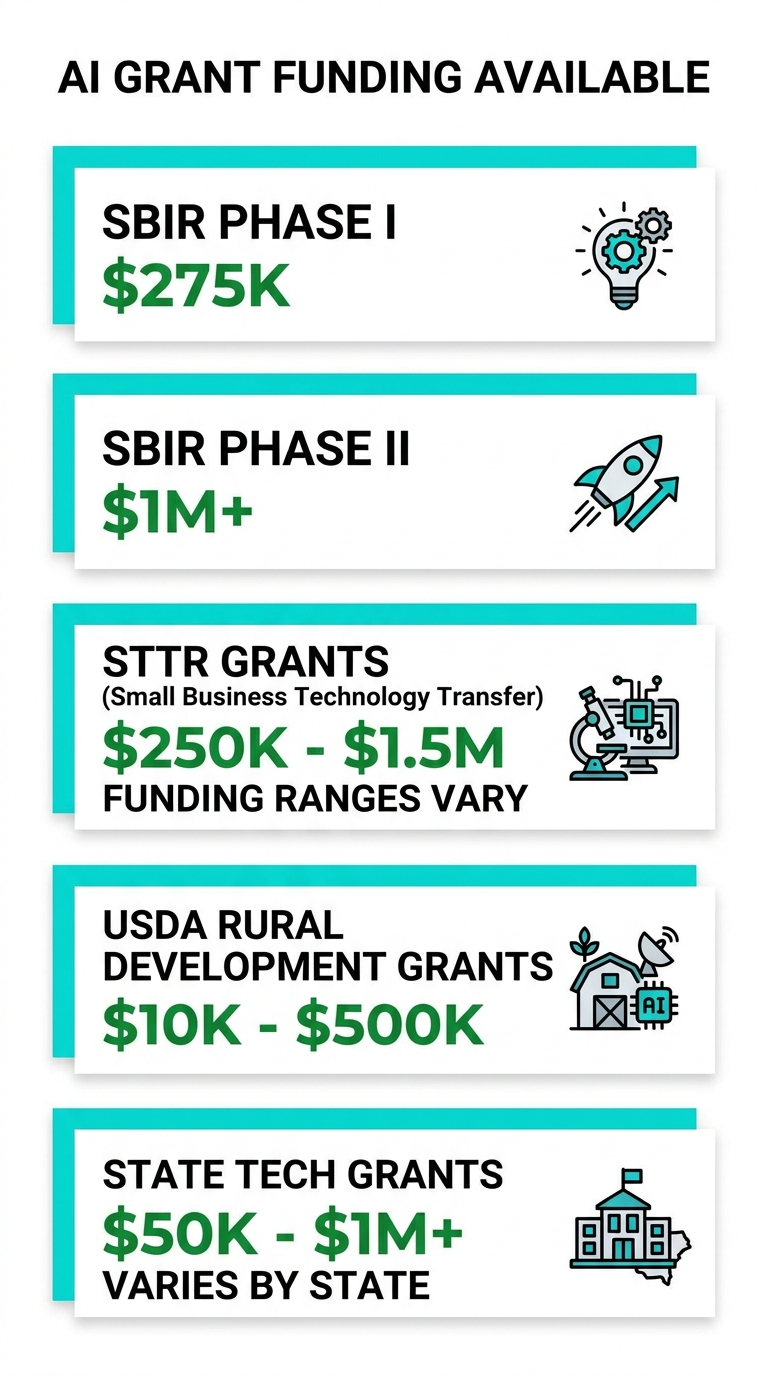
- SBIR Phase I grants: up to $275K for AI research and development
- USDA Rural Business Development Grants: up to $500K for rural tech adoption
- State-level programs vary wildly but many specifically fund AI and automation
- Most business owners don't apply because they don't know these exist
Free Money for AI. Seriously.
Let's get one thing straight.
This isn't about loans. Not SBA 7(a). Not microloans. Not any money you pay back.
This is about grants. Free capital. Government programs designed to help small businesses adopt new technology. Money that's allocated, budgeted, and waiting for someone to claim it.
And almost nobody applies.
The SBIR program alone awarded over $4 billion in grants in fiscal year 2023 (SBIR.gov). Billions. For small businesses developing and adopting innovative technology. Including AI. Including automation.
If you're a small business owner thinking about AI tools and automation but the budget feels tight, this is the article you need.
SBIR Grants: The Big One
What It Is
The Small Business Innovation Research (SBIR) program is the largest source of early-stage technology funding for small businesses in the United States.
Eleven federal agencies participate. They're required by law to set aside a percentage of their R&D budget for small businesses. That's not optional. It's congressionally mandated.
The result: billions of dollars available every year for small businesses working on innovative technology.
How Much Money
Phase I: Proof of Concept
- Amount: Up to $275,000
- Duration: 6-12 months
- Purpose: Determine feasibility of your AI innovation
- What you prove: "This idea works and here's the data"
Phase II: Full Development
- Amount: Up to $1,000,000+
- Duration: 24 months
- Purpose: Build and test the full solution
- What you deliver: A working product or system
Phase III: Commercialization
- Amount: No set limit (funded by the agency or private sector)
- Duration: Varies
- Purpose: Take it to market
- What happens: Your innovation becomes a real product
Who Qualifies
This is where most people count themselves out too early.
You qualify if:
- You're a U.S.-based small business (under 500 employees)
- You're at least 51% owned by U.S. citizens or permanent residents
- The principal researcher is employed by your business
- You're developing something innovative with commercial potential
You DON'T need:
- A PhD or academic credentials
- A laboratory or research facility
- Previous government contract experience
- Revenue minimums or years in business
Read that again. A small business owner who's developing an AI-powered solution for their industry can apply. You don't need to be a tech company. You need to be a company using tech innovatively.
What AI Projects Get Funded
SBIR grants fund AI projects across every federal agency. Examples:
- Department of Defense: AI for supply chain optimization, predictive maintenance
- Department of Energy: AI for energy efficiency analysis
- National Science Foundation: AI-powered analytics, machine learning applications
- Department of Health and Human Services: AI for patient scheduling, healthcare automation
- USDA: AI for agricultural technology, rural business applications
- Department of Commerce: AI for small business productivity
If your business uses AI to solve a real problem, there's likely an agency that funds it.
How to Apply
- Browse open solicitations at SBIR.gov
- Match your project to a specific agency's topic area
- Write a proposal (typically 15-25 pages for Phase I)
- Submit through the agency's portal before the deadline
- Wait for review (usually 3-6 months)
- If awarded, negotiate scope and begin work
Success rate: Roughly 15-25% of Phase I applications get funded, depending on the agency. Those aren't lottery odds. That's a real shot, especially if your proposal is well-written and your idea solves a documented problem.
STTR Grants: The Partnership Path
What It Is
The Small Business Technology Transfer (STTR) program is SBIR's cousin. Same money. Same structure. One key difference: you partner with a research institution.
How It Works
You: The small business that will commercialize the technology
Partner: A university, federal lab, or nonprofit research institution
Split: At least 40% of the work stays with your business, at least 30% goes to the research partner
Why It Matters for AI
If you want to develop a custom AI solution but don't have a data scientist on staff, STTR lets you partner with a university that does.
Your local university's computer science or business department becomes your R&D team. They bring the AI expertise. You bring the business problem and the commercial pathway.
Funding amounts: Same as SBIR. Phase I up to $275K. Phase II up to $1M+.
USDA Rural Business Development Grants
What It Is
If your business is in a rural area (population under 50,000), the USDA has grant money specifically for technology adoption.
The Details
Amount: $10,000 to $500,000
Who qualifies: Small businesses and nonprofit organizations in rural communities
What it funds:
- Technology-based economic development
- Business training and technical assistance
- Acquisition of technology
- Feasibility studies for technology adoption
Why It's Perfect for AI
Rural businesses face the same automation challenges as urban ones. Often worse, because the talent pool is smaller and hiring is harder.
AI closes that gap. A chatbot doesn't care if you're in Manhattan or Montana. An automated CRM works the same in rural North Carolina as it does in Silicon Valley.
The USDA gets this. Their Rural Business Development Grants explicitly fund technology that helps rural businesses compete.
How to apply: Through your state's USDA Rural Development office. Applications typically open annually with deadlines in the spring.
State-Level AI and Technology Grants
The Hidden Gold Mine
Every state has economic development programs. Many of them now specifically target technology adoption and AI.
Here are the types of state programs to look for:
Technology Adoption Grants
Many states offer direct grants for small businesses adopting new technology. These are typically $5,000-$100,000 and require you to show how the technology improves productivity or creates jobs.
Examples:
- North Carolina: The One NC Small Business Program provides grants for tech-related startups and expansions
- Ohio: The Technology Validation and Start-Up Fund provides up to $150K for tech commercialization
- Texas: The Small Business Innovation Research (SBIR) Matching Grant Program matches federal SBIR awards dollar-for-dollar
- Pennsylvania: The Ben Franklin Technology Partners provides grants and investments for tech adoption
- Michigan: The Small Business Innovation Research support program helps with SBIR proposal development
Workforce Development Grants
These are sneaky good for AI funding.
States pour money into workforce training. If implementing AI requires training your team (and it does), workforce development grants can cover those costs.
Training your staff on a new CRM system? Grant-eligible.
Upskilling employees on AI-powered tools? Grant-eligible.
Hiring a consultant to train your team on automation workflows? Often grant-eligible.
How to Find Your State's Programs
- Search "[Your State] small business technology grant" for a starting point
- Contact your SBDC (Small Business Development Center) - they track every program and help you apply for free
- Check your state's economic development agency website
- Ask your local Chamber of Commerce - they often know about programs nobody else does
Your SBDC advisor will know every grant available in your area. This is literally their job. And the advice is free.
SBA's Own Grant-Adjacent Programs
The SBA doesn't give direct grants to small businesses (that's a common misconception). But they fund organizations that do.
Community Advantage Loans
Not technically grants, but these are loans through nonprofit lenders specifically designed for underserved communities. Lower rates. More flexible terms. Often combined with technical assistance that IS grant-funded.
SCORE Mentorship + Grant Connections
SCORE is an SBA-funded network of volunteer business mentors. Free. They don't give grants themselves, but experienced SCORE mentors know every funding source in your area and can connect you to programs you'd never find on your own.
Small Business Development Centers (SBDCs)
SBA-funded. Free consulting. And they help you find and apply for grants as part of their service. There are roughly 1,000 SBDCs across the country. Find yours at sba.gov/sbdc.
Private and Nonprofit AI Grants
Government isn't the only source.
Tech Company Programs
Several major tech companies offer grants and credits for small businesses adopting AI:
- Google for Startups: Cloud credits and AI/ML training grants
- Microsoft for Startups: Up to $150K in Azure credits including AI services
- AWS Activate: Up to $100K in cloud credits for startups
- NVIDIA Inception: GPU credits and AI development resources
These aren't cash grants, but $100K in cloud credits for AI development is real money you don't have to spend.
Foundation Grants
Nonprofits and foundations increasingly fund small business technology adoption:
- Kauffman Foundation: Various programs supporting tech entrepreneurship
- National Science Foundation I-Corps: Commercialization training with funding
- Economic Development Administration (EDA): Build to Scale grants for tech ecosystems
How to Actually Win These Grants
Most grant applications fail for the same reasons. Here's how to be in the percentage that doesn't.
1. Match Your Project to Their Priorities
Don't twist your business idea to fit a grant topic. Find the grant topic that matches what you're already building. When the alignment is natural, the proposal writes itself.
2. Lead With the Problem, Not the Technology
Wrong: "We want to implement a transformer-based NLP model for customer interaction analysis."
Right: "Our customers wait 4 hours for responses. We lose 35% of leads to faster competitors. Our AI solution responds in under 30 seconds, 24/7."
Grant reviewers care about impact. Not buzzwords.
3. Show the Numbers
- How many hours saved per week
- How much revenue generated or costs reduced
- How many jobs created or retained
- What the measurable outcomes will be at 6 and 12 months
Our ROI calculator can help you build these projections with real data.
4. Get Help With the Application
SBDC advisors help with grant applications. For free. They've seen hundreds of applications and know what reviewers look for. Use them.
For SBIR specifically, many states offer SBIR proposal development assistance programs. Some even pay for professional grant writers to help with your application.
5. Apply Early and Apply Often
Grant programs have cycles. Miss one deadline? Apply to the next one. Got rejected? Read the feedback, improve, and resubmit.
The businesses that get funded aren't the ones with the best ideas. They're the ones that kept applying.
The AI Adoption Timeline Nobody Talks About
Here's what makes grants particularly powerful for AI.
Loans start costing you money the moment you receive them. Interest accrues. Payments begin.
Grants give you a runway. Time to implement, test, iterate, and prove ROI without the pressure of monthly payments.
That means you can:
- Take 3 months to properly set up your CRM and automation instead of rushing
- Invest in thorough team training instead of cutting corners
- Build custom integrations that fit your workflow instead of settling for generic solutions
- Test and optimize before scaling
The result is better implementation. Better adoption. Better returns.
Stop Leaving Money on the Table
Here's the reality.
These programs exist because the government and private sector want small businesses to adopt AI. It's economic policy. A more productive small business sector means more jobs, more tax revenue, and a more competitive economy.
They're not doing you a favor. They're investing in economic infrastructure. And you are the infrastructure.
But they can't force you to apply. That part's on you.
Start with one application. Pick the program that fits best. Write the proposal. Submit it.
The worst that happens? You get rejected and apply to the next one.
The best that happens? You get free money to build the AI-powered business your competitors are paying full price for.
Not sure which grants you qualify for or what to automate first? We'll audit your operations, identify the highest-ROI automation opportunities, and point you to the funding programs that match.
Book a free system audit and start building with other people's money.
Related reading:
Ready to Automate Your Business?
Book a free strategy call and we'll map out exactly what to build first.
Book Your Call
Join the Conversation