

- Score processes on revenue impact, frequency, rework, owner dependency, and consequence. Document the top few, not all of them.
- The five that matter first: delivery, the sales to delivery handoff, client onboarding, billing and collections, and continuity.
- 71% of small businesses depend on one or two people (Nationwide, 2026). That is the risk an SOP actually retires.
Ask an Owner Where Their Processes Live
You get one of three answers.
"In my head."
"In a Google Doc somewhere."
"We tried that once."
All three mean the same thing. You are the system. Every quote, every kickoff, every invoice, every awkward client conversation routes through one person, and that person is reading this right now on a Sunday.
This is not a discipline problem. You are not lazy. You are running a business that grew faster than its wiring, and the wiring is you.
What It Actually Costs You
The bill shows up as time, and time is easy to ignore because it never arrives as an invoice.
Businesses with 10 to 99 employees reported spending an average of 25 hours a week on manual data entry and reconciling information across applications, according to Intuit QuickBooks' 2024 Business Solutions Survey of 630 US owners and executives. More than half, 54%, named excessive manual and repetitive tasks as a top challenge.
Then there is the tax on finding anything. In Atlassian's State of Teams 2025 report, 56% of workers said the only way to get the information they needed was to ask a person or schedule a meeting. A quarter of the work week goes to searching for answers.
That second number is the whole point of this article. Those people were not missing documentation. They were missing documentation they could find at the second they needed it.
The quality side has a number too. The American Society for Quality puts the cost of poor quality in a functioning company at roughly 10% to 15% of operations, which covers failures, rework, and inspection.
One honest note before we go further. You will see articles claiming that some precise percentage of small businesses have no documented procedures. There is no defensible national source for that number. Not the SBA, not the Census, not a peer-reviewed study. Anybody quoting it is repeating a vendor's customer list as if it were the country. I would rather hand you six real numbers than seven with a fake one in the middle.
Here's the Thing About Documenting Standard Operating Procedures
A folder full of instructions is not a system. It is inventory.
A company can hold 60 documented procedures and still route every escalation to the owner. A four-person shop can run clean on six checklists and one decision table.
The page count was never the thing. An SOP changes something only when it is built into the place the work starts. Everything else is a writing project.
So before you write a single word, you need a filter.
The Filter: Which Processes Earn an SOP
Business process management research is consistent on this. You pick processes by how much the business rides on them, how badly they run today, and whether they hold still long enough to pin down. Not by which one is easiest to write.
Score every candidate process 1 to 5 on five questions:
- Revenue and trust. If this fails, how much money or client confidence walks out?
- Frequency. How often does it run, and how many hours does it eat?
- Rework. How much chasing, fixing, and doing-it-twice happens today?
- Owner dependency. Would this stall if one person vanished for two weeks?
- Consequence. Can failure create a legal, cash, or continuity problem?
Document the top two or three. That is it. Then come back next quarter.
This is the same instinct EOS built its process component around: find the 20% of processes driving 80% of the results and document those at a level a competent adult can follow. Not every click. The vital few.
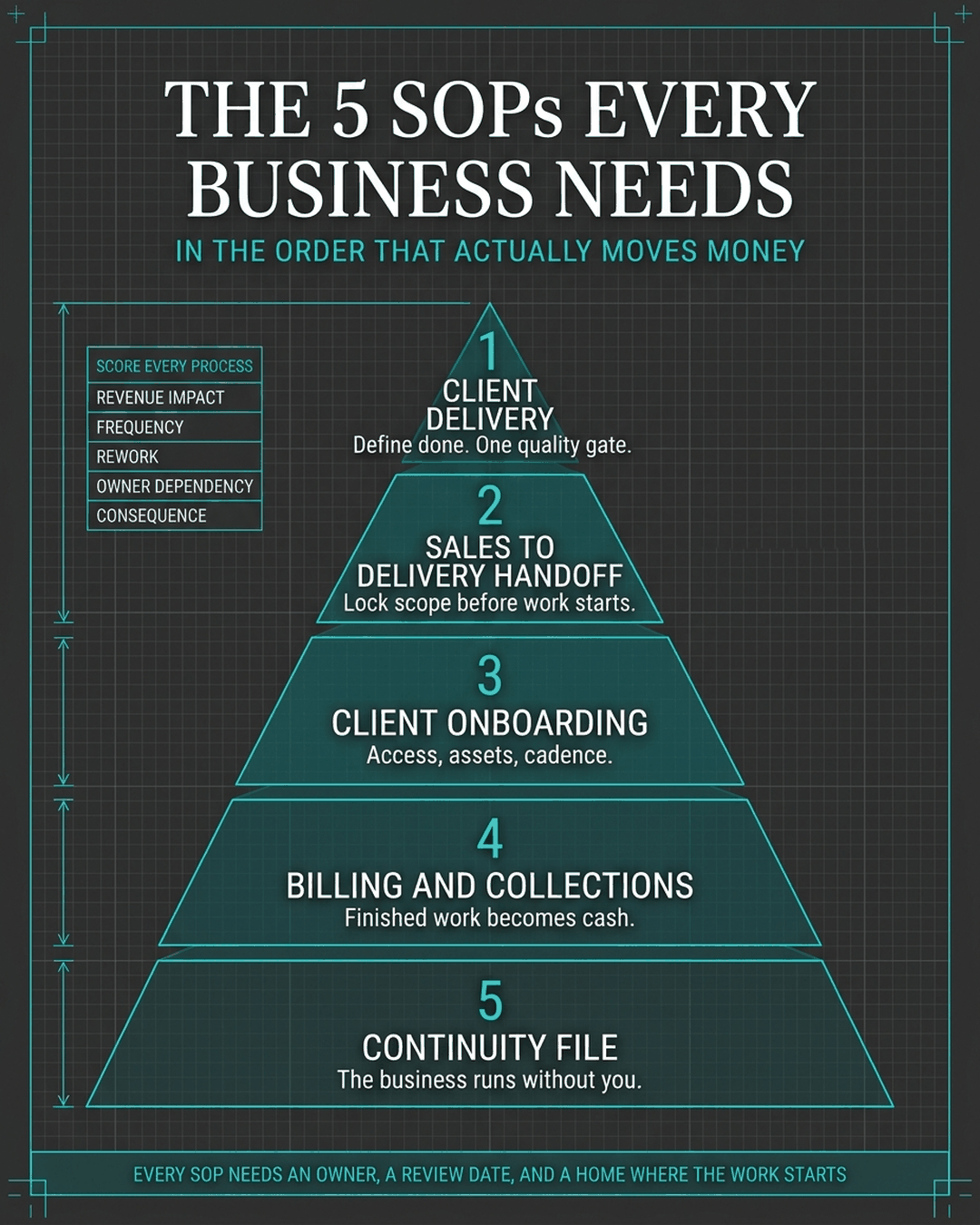
The 5 SOPs Every Business Needs
Most SOP lists start with the easy stuff. How to file an expense. How to post to social. Those are simple to write, which is exactly why they get written first and why they change nothing.
Here is the order that actually moves money, based on where small service businesses lose it.
1. Client Delivery and the Definition of Done
This is the process that creates the thing people pay you for. It absorbs most of your labor, and every wobble in it hits margin, retention, and referrals at the same time. Start here even though it feels like the hardest one.
What goes in it:
- What "done" means, in writing, per deliverable
- What you need from the client before work can start
- The stages, and who owns each one
- Templates for whatever gets produced
- One quality gate before anything reaches the client
- What variation is allowed and what is not
- Escalation rules for when it goes sideways
The definition of done is the highest-value line in the whole document. Most delivery rework is not incompetence. It is two people holding different pictures of finished.
2. The Sales to Delivery Handoff
In expertise businesses, the promise lives in the founder's mouth and the delivery lives in somebody else's calendar. That gap is where underpricing, scope creep, and instant rework are born.
What goes in it:
- Who you take and who you turn down, in specifics
- Discovery questions that are always asked
- Scope and pricing rules, including what requires approval
- Promises sales may make, and the ones nobody may make
- A signed-scope checklist before kickoff
- The fields that must be filled in your CRM before handoff
- A handoff meeting with an agenda, not a Slack message
If you only document two things this year, make it this one and the one above it.
3. Client Onboarding
Onboarding is frequent, highly visible, and completely dependent on collecting access, assets, goals, and approvals on time. It is also the first impression of whether you are organized, which is what the client is actually buying.
What goes in it:
- The welcome sequence and what triggers it
- Payment and contract gate
- Access and asset checklist, itemized
- Kickoff agenda
- Who does what on the client's side, named
- Communication cadence and where it happens
- What happens when the client goes quiet
This one automates well. A marketing automation platform can run most of the sequence, and the SOP becomes the part humans still touch.
4. Billing and Collections
Finished work is not revenue. Collected work is revenue. This process is repetitive, measurable, and constantly delayed by a missing approval or a founder who has not sent the invoice yet.
What goes in it:
- What triggers an invoice, exactly
- Where the numbers come from
- Who approves, and above what amount
- Payment terms, in plain language
- The overdue cadence, day by day, and who sends it
- How disputes get handled
- Who can write something off
- One accounts receivable number you look at weekly
Scaling Up uses billing and collecting as its example of a core cross-functional process for a reason. It touches everyone and it converts your work into your payroll.
5. The Continuity File
This is the one nobody writes and everybody needs. It is low-frequency and high-consequence, which is the exact profile humans are worst at planning for.
Nationwide, citing National Association of Insurance Commissioners research, reports that 71% of small businesses depend on one or two people for organizational success. In UK research published by Scottish Widows in August 2026, covering more than 2,000 business owners, 23% said they would cease trading within a month of losing a key person, and 10% said they would stop immediately if the owner became incapacitated.
What goes in it:
- Where the credentials live and who can reach them
- Banking and payment authority
- Which client belongs to which relationship
- Where contracts are stored
- Who decides what, if you are unreachable
- A minimum operating checklist to keep the lights on
- One cross-trained backup per critical process
There is an exit angle too. The Exit Planning Institute estimates only about 20% to 30% of businesses that go to market actually sell. Buyers pay for a business that runs without you. They discount one that is a person with invoices.
A note on employee onboarding. It is number six, and it jumps to number two the moment you hire regularly. SHRM reported in 2023 that organizations with standardized onboarding saw 50% greater new-hire productivity. Fair warning on that stat: it measures structured onboarding as a whole, including manager involvement and practice, not documentation by itself.
Why Most SOPs Get Ignored
You can do all of the above and still end up with a graveyard. Here is how it happens.
You documented a broken process. Writing down a bad workflow preserves it, approvals and workarounds included. Watch the work, cut the waste, then write.
Nobody owns it. Every live SOP needs a named owner, an approval date, a version, and a next review date. Without an owner, no one keeps it true.
It is too long. Nobody reads eleven pages to send an invoice. Layer it instead: a one-page map, a checklist, then optional detail or a two-minute screen recording.
It lives somewhere else. This is the big one. If the procedure sits in a drive folder and the work starts in your CRM, the folder loses. Put the checklist inside the pipeline stage, the project template, the ticket.
It went stale quietly. Trigger a review on events, not just the calendar: tool changes, a bad miss, a role change, a pricing change. Quarterly for anything critical, annually for the stable stuff.
You do not follow it. The moment the founder skips intake or approves off-book, the document becomes a suggestion. EOS treats "followed by all" as a separate requirement from documenting, and they are right to.
Nobody measured anything. Pick one number per SOP. Cycle time. First-pass acceptance. Days to collect. If the number does not move, the SOP is decoration.
What to Do This Week
Three things. Small enough to actually happen.
One, score your processes. List every recurring process. Score each on the five questions above. Circle the top two.
Two, write the ugly first version of one. Not a polished manual. A one-page checklist with a definition of done, an owner, and a review date. Ugly and used beats beautiful and buried.
Three, move it into the work. Paste it into the pipeline stage, the project template, the onboarding automation. If it does not live where the task starts, it does not exist.
Then run it twice yourself before you hand it to anyone. You will find three things wrong. That is the point.
Frequently Asked Questions
How many SOPs does a small business actually need?
Fewer than you think. Most businesses under 20 people run well on five to ten documented core processes plus checklists underneath them. The failure mode is a 60-document library nobody opens, not a missing procedure for filing receipts.
What is the difference between an SOP, a checklist, and a policy?
A policy says what must be true. A process map shows the flow and the handoffs. An SOP explains how and who. A checklist confirms the critical steps in the moment. A template standardizes the output. One document trying to be all five is the reason most SOPs go unread.
Should I use AI to write my SOPs?
Use it to turn a recording of you doing the work into a first draft, and to rewrite the ten-page version into a one-page checklist. Do not let it invent your process. It does not know your approval limits, your pricing rules, or which client is a problem. Draft with AI, decide yourself. Same rule that applies to any of the AI agents worth running in a small business.
How often should SOPs be reviewed?
Quarterly for anything critical or fast-changing, annually for stable low-risk work, and immediately after a tool change, a role change, or a visible failure. Put the next review date on the document itself.
The Real Test
Take two weeks off. Not a laptop-open vacation, an actual absence.
Whatever breaks is your next SOP. Whatever holds is a system you already built and never gave yourself credit for.
Most owners never run that test because they already know the answer. That is the information, and it is free.
If you would rather not learn it the hard way, book a call and we will map the two processes worth documenting first, then build them into the tools you already pay for.
Ready to Automate Your Business?
Book a free strategy call and we'll map out exactly what to build first.
Book Your Call
Join the Conversation