

Everyone's watching GPT-5 versus Gemini 3 like it's a sports rivalry.
Meanwhile Anthropic quietly shipped the updates that let a 2-person HVAC office run the same agent stack that Fortune 500s pay consultants $200k to build.
None of these landed with a keynote. No logo redesign. No "state of AI" tour. Just a steady drip of release notes that rewrote the economics of what's possible — if you were paying attention.
Most of your competitors weren't.
Here's what actually shipped and what to do with it before the rest of your market catches up.
Update 1: 1-Million-Token Context Is Now Standard Pricing
Shipped: March 13, 2026 (Claude blog)
This is the one that matters the most, and almost nobody is talking about it.
Claude Opus 4.6 and Sonnet 4.6 now ship with 1 million tokens of context at the regular price. Previously, long-context mode cost roughly 2x. Now it's the default. You pay the same whether you send 2,000 tokens or 800,000.
What 1 million tokens actually looks like:
- An entire year of customer support emails
- Every service ticket from the last 18 months
- Your full SOP library, every vendor contract, and every job history
- A 200-page franchise agreement with all addendums
- The complete transcript of every sales call you've had this quarter
All in one prompt. Processed together. With Claude holding every detail in active memory instead of forgetting page 3 by the time it reads page 200.
Opus 4.6 scored 76% on multi-needle retrieval at 1M context versus 18.5% for Sonnet 4.5 — a 309% improvement (Anthropic). Translation: it doesn't just hold the big context. It can actually find the right detail buried inside it.
What this means for your business
A property management company can paste every tenant email thread from the past 12 months and ask: "Which tenants are showing churn-risk signals and why?" In one shot. No RAG setup. No vector database. No engineering team.
An HVAC shop can feed Claude every warranty claim, every manufacturer spec sheet, and every past estimate, and ask: "For this job at 1247 Oak Street, what's the realistic cost and what are the three most common call-backs I should prep for?"
A legal practice can load the full discovery file — all of it — and get summaries, contradictions, and missing-evidence flags without paying a paralegal 40 hours to read it first.
This is the kind of work that needed a full engineering team eight months ago. Now it's a single API call at standard pricing.
Update 2: Managed Agents — No Server, No Developer, No Problem
Shipped: April 8, 2026 (public beta, platform.claude.com)
Until this month, if you wanted a Claude-powered agent running 24/7 in your business, you needed a developer, a server (Railway, Fly.io, AWS, whatever), a session store, a memory system, and someone to babysit it when it crashed.
Anthropic just removed all of that.
Managed Agents means Anthropic hosts the whole thing. You define what the agent should do and what tools it can use. They run the sandbox, the memory, the session state, the scaling, and the reliability. You get an endpoint.
No DevOps. No uptime pages. No 3 AM alerts.
What this means for your business
A roofing company can now stand up an intake agent that:
- Fields every form submission from their site
- Pulls the prospect's address from the lead
- Checks county permit history for the property
- Books a consultation slot that matches the rep's calendar
- Writes a pre-meeting briefing so the rep walks in informed
No developer. No server. No maintenance.
Same architecture for any service business — real estate follow-up, HVAC triage, legal intake, medspa booking, coaching onboarding. The agent runs on Anthropic's infrastructure. You just configure it.
This is the "AI agent" promise that was 80% vaporware for two years. It's not vaporware anymore.
Update 3: The Advisor Tool — Opus Quality at Haiku Prices
Shipped: April 9, 2026 (public beta)
This one is the sleeper. Nobody's talking about it. It's the most practical update of the year.
Here's how it works. You run your agent on Claude Haiku 4.5 — cheap and fast. Good enough for 90% of interactions. But Haiku occasionally hits a hard question — a high-value lead, a complicated objection, a nuanced edge case.
Instead of handing the problem to Haiku and praying, you plug in the Advisor Tool. When Haiku hits a tough moment, it phones Opus 4.6 for strategy, gets the plan back, and keeps executing.
You get Opus-level reasoning on the hard stuff. You pay Haiku pricing on everything else.
What this means for your business
Every speed-to-lead bot you run just got radically cheaper without losing quality.
Concrete example. A roofing speed-to-lead agent fielding 500 inbound leads a month:
- Without Advisor: all 500 on Opus = expensive
- With Advisor: 460 on Haiku, 40 tough cases escalated to Opus = roughly 70% cost reduction, same close rate
This is the first update where "production AI" stops being a cost center and starts being a margin lever.
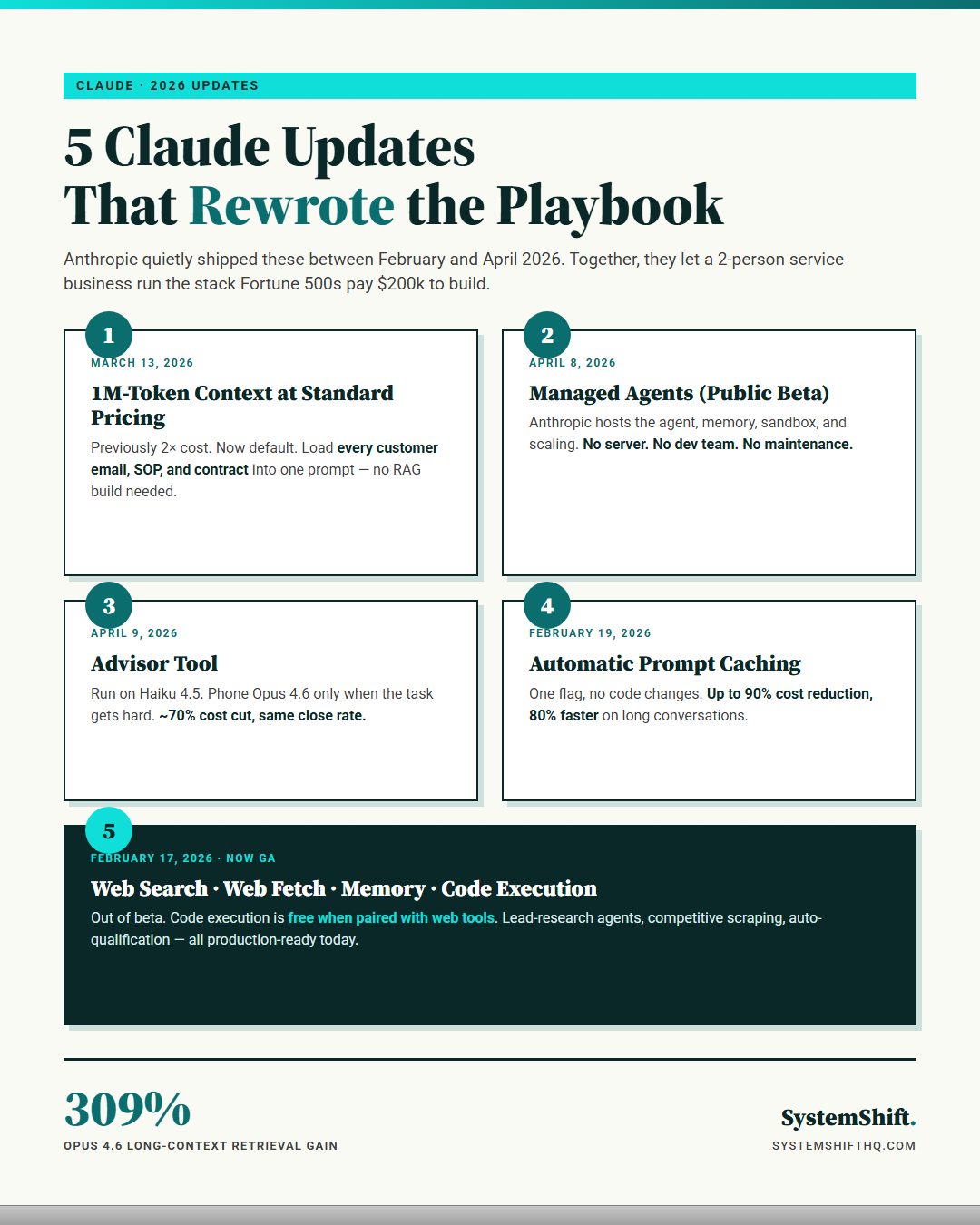
Update 4: Automatic Prompt Caching
Shipped: February 19, 2026
Short one, big impact.
Before this update, if you wanted prompt caching (the thing that makes Claude cheap and fast when you're reusing context), you had to manually mark cache breakpoints in your prompt. Most businesses never did, because nobody told them it existed.
Now it's automatic. Add one field to your API call. Claude figures out what to cache.
The result: up to 90% cost reduction and 80% latency reduction on long conversations (Anthropic).
What this means for your business
Every chatbot, CRM assistant, and customer support AI you've already built in production just got cheaper and faster. You don't rewrite anything. You flip one flag.
If you're running any kind of ongoing Claude conversation — a support chatbot, a CRM copilot, an always-on research agent — your monthly AI bill should drop noticeably. If your vendor or agency hasn't enabled this for you yet, ask why.
Update 5: Web Search, Web Fetch, Memory Tool, and Code Execution Are Now GA
Shipped: February 17, 2026
For two years, Claude could "do things in the world" — browse the web, fetch URLs, remember across sessions, run code — but all of it was in beta. Enterprise clients were nervous. Agencies were nervous. Nobody wanted to build on "beta."
On February 17, Anthropic moved all of it to general availability. And code execution is now free when paired with web search or web fetch.
What this means for your business
A lead-research assistant can now:
- Scrape a prospect's Google Business Profile
- Pull their last 20 reviews
- Parse sentiment and common complaints
- Pull their competitors' reviews for comparison
- Compute a "vulnerability score" and send your sales rep a briefing
All from one Claude call. Web access is GA. Code execution is free. Memory persists across calls.
That same stack at any enterprise automation consultancy costs $40k+ to build. You can prototype it in an afternoon.
How To Actually Use This
Five updates. Massive combined impact. Here's how a real service business should think about the stack.
1. Start With Managed Agents, Not a Custom Build
Unless you already have a dev team, your first production agent should live on Managed Agents. Skip the server conversation. Skip the hosting decision. Skip the "should we use n8n or Make or a custom Python thing" debate.
Define the agent's job. Point it at the tools it needs. Let Anthropic run it.
You can always graduate to a custom build later if scale demands it. Most businesses never need to.
2. Use the Advisor Tool for Anything Customer-Facing
If you're building an agent that talks to leads, customers, or prospects — use Haiku 4.5 as the base model and plug in the Advisor Tool.
You'll pay Haiku pricing on routine conversations and Opus pricing only on the complex turns. Cost profile looks like 20% of full-Opus pricing. Quality profile looks like 95% of full-Opus quality.
This is the right configuration for speed-to-lead bots, intake agents, support automations, and follow-up sequences — anywhere volume meets nuance.
3. Stop Rebuilding What 1M Context Makes Unnecessary
Half the "custom AI" projects service businesses pay agencies for are really just "I need Claude to remember more." With 1M context at standard pricing, most of those projects are now a single prompt.
Before you pay anyone to build you a RAG system or a custom memory layer — try the 1M context window first. Paste your whole dataset in. See what happens. You'll be surprised how often it just works.
4. Turn On Automatic Caching Yesterday
If you have any Claude-powered system in production, ask your developer or vendor to enable automatic prompt caching. This is a five-minute change that can cut your AI bill by 60-90%.
There is no downside. There is no migration. If someone tells you "it's complicated," find someone else.
5. Rebuild Your Lead Research Stack Around GA Tools
Any lead qualification, prospect research, or competitive intelligence workflow you've built on third-party APIs — revisit it. With web search, web fetch, code execution, and memory all GA (and code execution free with web tools), a lot of the paid-API dependency goes away.
The businesses that figured this out in February already cut their research costs. The ones still paying per-lookup to five different SaaS tools haven't looked at their Claude release notes in three months.
What This All Adds Up To
Every one of these updates, on its own, is useful.
Together, they're a rewrite of what's possible for a small service business to automate without a technical team.
A year ago, standing up a lead-qualification agent with long-term memory, web research, tool use, and Opus-level reasoning on tough calls required a dedicated engineer, a server, a vector database, a caching layer, and about six weeks of integration work.
Today: Managed Agents, 1M context, Advisor Tool, auto-caching, GA tools. Roughly a weekend for someone who knows what they're doing. Free cost floor, pay-as-you-grow ceiling.
The gap between businesses that know this stack and businesses that don't is about to get enormous.
56% of CEOs say they got "nothing" from their AI investment (Fortune/PwC). That gap doesn't close because the tools got better. It closes because someone actually builds the systems that use them.
Stop Watching. Start Building.
These updates are live right now. Not "coming soon." Not "in Q3." Live.
If you're a service business owner reading this thinking "I should do something with Claude" — the tools are no longer the bottleneck. Your systems are. Your CRM, your intake process, your follow-up cadence, your data hygiene.
That's the part nobody else is going to solve for you.
SystemShift builds the automation systems that turn these Claude updates into actual business output. We design the workflows, wire up Managed Agents to your GHL or AppFolio or whatever stack you're on, and make sure the AI capacity you're paying for actually shows up in your revenue numbers.
Book a free strategy call and let's map what's automatable in your business with the stack that exists today.
Not next year. Today.
-Rock
Ready to Automate Your Business?
Book a free strategy call and we'll map out exactly what to build first.
Book Your Call
Join the Conversation