

You run a service business.
You don't have time to double-check every line an AI spits out. You need it to do the work and tell you the truth about what it did.
That's the whole story of Claude Opus 4.8 for business. Not faster. Not flashier. More honest.
On May 28, 2026, Anthropic shipped Claude Opus 4.8, just 41 days after 4.7. Everyone in the AI news cycle is reciting benchmarks. I'm going to tell you what actually changed for someone running an HVAC company, an agency, or a coaching practice: you can finally hand it a multi-step job and trust the result.
If you're new to this model line, read our Claude Opus 4.7 for business breakdown first, then come back. This post is the next chapter.
What Claude Opus 4.8 for business actually changed (honesty, not hype)
Claude Opus 4.8 for business is Anthropic's May 28, 2026 release positioned as their most honest model: it flags its own uncertainty, makes fewer unsupported claims, shows sharper judgment, and works independently for longer stretches. In plain English, it stops bluffing.
Here's why that matters more than any benchmark.
The old problem with AI wasn't that it was dumb. It was that it was confidently wrong.
It would invent a price. Make up a policy. Cite a review that never existed. And it said all of it with total confidence, so you had to check everything. That's the tax that killed AI for most owners. If you have to verify every output, you didn't save any time.
Opus 4.8 attacks that tax directly:
- It flags uncertainty. Instead of guessing, it tells you when it's not sure.
- Fewer made-up claims. It makes far fewer unsupported statements, so the output is closer to send-ready.
- Sharper judgment. It knows when a task is done versus when it needs your input.
- Longer solo runs. It stays on track through more steps without drifting or needing a nudge.
Translation for your business: less babysitting, more trusting. That's the unlock.
Claude Opus 4.8 for business benchmarks: the numbers that back the story
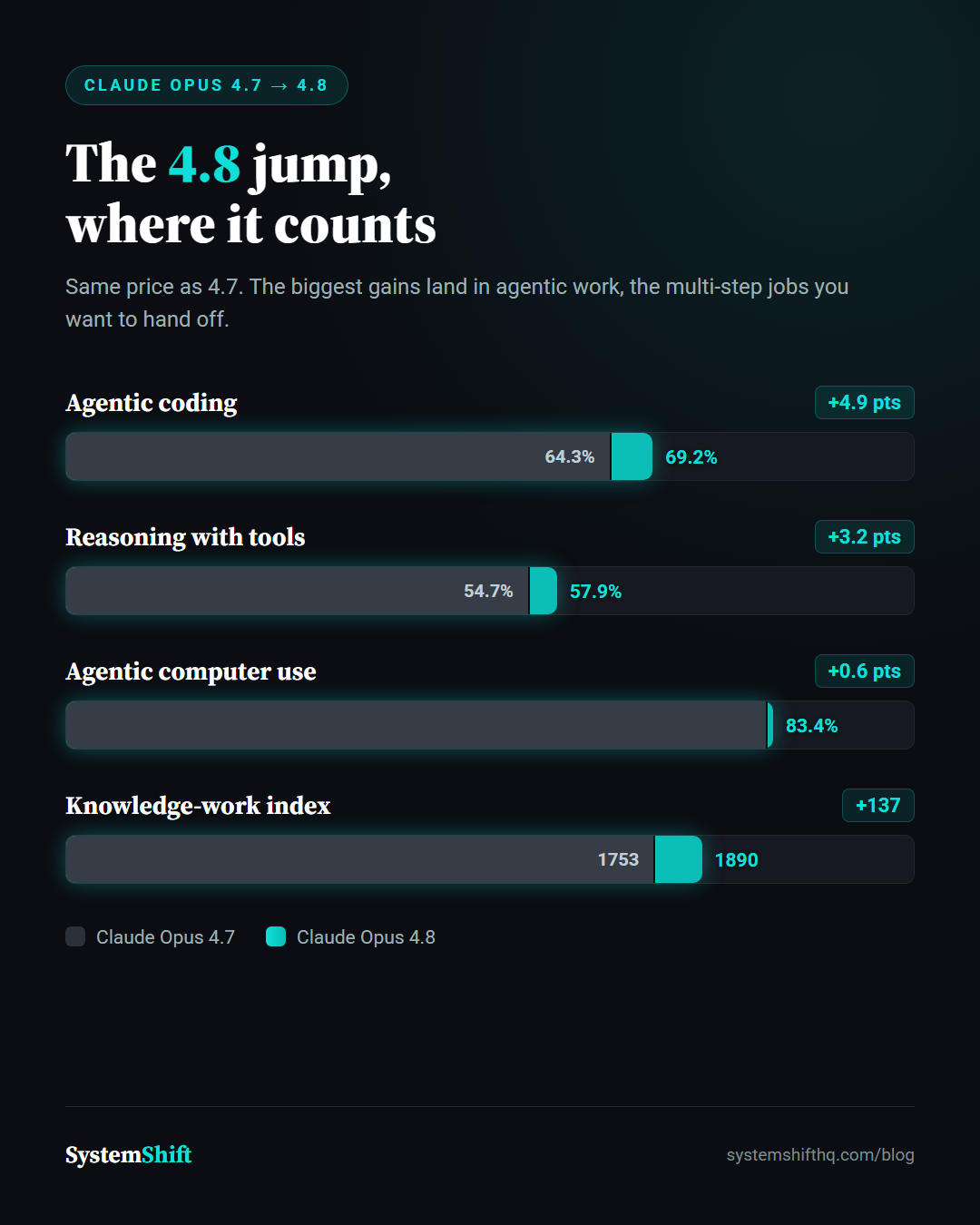
Claude Opus 4.8 for business posts real gains over 4.7 across coding, reasoning, and computer-use tasks, with the biggest jumps in agentic work, which is exactly the kind of multi-step job a service owner wants to hand off.
You don't need to memorize these. You just need to see that "more honest" came with "more capable."
| Capability | Claude Opus 4.7 | Claude Opus 4.8 | What it means for you |
|---|---|---|---|
| Agentic coding | 64.3% | 69.2% | Builds and fixes automations with fewer errors |
| Multidisciplinary reasoning with tools | 54.7% | 57.9% | Better at jobs that mix data, tools, and judgment |
| Agentic computer use | 82.8% | 83.4% | Clicks through your apps more reliably |
| Knowledge-work index | 1753 | 1890 | Stronger at real office work, not just trivia |
A few more that matter:
- Web agent (Online-Mind2Web): 84%. It beats both 4.7 and GPT-5.5 at navigating live websites.
- Legal Agent Benchmark: the first model ever to break 10% on a brutally hard legal test.
- Super-Agent: the only model to complete every case end to end.
The pattern is clear. The gains cluster in agentic work, the multi-step, run-it-yourself tasks. That's the work you want off your plate.
Same price as 4.7: better model, zero extra cost
Claude Opus 4.8 for business costs exactly what 4.7 cost: $5 per million input tokens and $25 per million output tokens, with the same 1-million-token context window. You get a better model at the same price.
This part is easy to miss, so read it twice. Nothing about the price went up.
- $5 per 1M input tokens. Unchanged.
- $25 per 1M output tokens. Unchanged.
- 1M-token context window. Still here. That's roughly a year of your emails, invoices, and chats in a single prompt.
- Prompt caching up to 90% off. Repeated context gets cheap fast.
- Batch processing 50% off. Run big overnight jobs for half price.
So the math is simple. If you were already using 4.7, switching to 4.8 is a free upgrade. Same bill, better work, fewer mistakes to clean up. That almost never happens in software. Take it.
Dynamic Workflows: hundreds of helpers in one job (Claude Code feature)
Dynamic Workflows is a new research-preview feature in Claude Code, Anthropic's developer tool, that lets you plan one big job and run hundreds of parallel subagents in a single session. It's how one prompt becomes a whole team working at once.
Quick clarification so nobody gets confused. There are two Claudes. Claude is the chat app most people use in a browser. Claude Code is the developer command-line tool. Dynamic Workflows lives in Claude Code, so it's more of a "your tech person sets this up" feature than a click-it-yourself one.
But here's why it matters even if you never touch the command line:
- Plan once, run many. You describe a big job, and Claude breaks it into hundreds of small tasks that run at the same time.
- 3x cheaper fast mode. The new fast mode runs jobs at a third of the cost.
- Adaptive thinking. The model scales its effort to match the task. Simple jobs run quick and cheap. Hard ones get more thinking.
Picture this for an agency: "Audit all 40 of my clients' landing pages, flag the broken forms, and draft a fix list for each." With Dynamic Workflows, that's not 40 separate sessions. It's one job, 40 helpers, one report. That's the kind of leverage that used to require hiring. For more ground-level ideas, see our post on 3 AI agents every business owner can use.
Claude Opus 4.8 vs 4.7 for service businesses: should you switch?
Claude Opus 4.8 vs 4.7 comes down to one question for service owners: do you want fewer mistakes and longer solo runs at the same price? If yes, switch now. There's no cost penalty and the reliability gain is real.
Here's the honest read. If you're already running Claude in your business, the move to 4.8 is a no-brainer: same price, more reliable output, less checking. Flip the switch.
If you're not using Claude yet, 4.8 is a better starting point than 4.7 ever was, because the number one objection ("I can't trust it") just got smaller.
Where 4.8 wins for service owners:
- Multi-step jobs. Lead triage, proposal drafting, review responses, monthly customer reviews. The agentic gains land right here.
- Trust. Fewer made-up claims means less time spent fact-checking the AI.
- Cost. Same price as 4.7, plus a 3x cheaper fast mode in Claude Code.
Keep ChatGPT for creative media: image, voice, and video generation are still its lane. Most of my clients run both. The real question isn't which app. It's which one you'll trust to run a job start to finish. Right now, 4.8 just made that easier to say yes to.
The catch (honest tradeoffs)
I'm not going to oversell it. Here's what's real.
- "More honest" is not "perfect." It makes fewer made-up claims. Fewer is not zero. Spot-check anything that touches money or legal.
- Dynamic Workflows is a research preview. It's early, it lives in Claude Code, and it'll change. Don't bet a client deadline on it yet.
- The big wins are in agentic work. If you only use Claude as a glorified search box, you won't feel most of this. The gains show up when you hand it real multi-step jobs.
- The hype train is loud. Anthropic teased "Mythos-class" models for the coming weeks and raised $65B around this launch. Ignore the noise and judge it on your own workflows.
- Keep sensitive data scoped. Check the data policy, keep client data in scoped projects, don't dump your crown jewels into a public prompt.
Treat 4.8 like a sharp new hire who finally tells you when they're unsure. Trust grows from there. That's the whole point of this release.
Want Claude Opus 4.8 running in YOUR business? Let's build it.
You can read every AI release post and still be stuck on the sidelines. Or we can put Claude Opus 4.8 for business to work on the boring, repeatable, revenue-moving stuff this week.
SystemShift builds AI operators that run the recurring work for owner-operators. Lead triage. Follow-up. Review responses. Monthly customer reviews. The jobs you keep meaning to systemize and never do.
No code. No Zapier spaghetti. No hiring a dev.
Here's what to do next:
- See the stack: Meet our SystemShift AI agents. The same pre-built operators we deploy for clients.
- Book a call: Tell us what's eating your week. Reach out here and we'll show you exactly what to automate first.
The model got more honest.
The question is whether you'll trust it with real work before your competitor does.
Ready to Automate Your Business?
Book a free strategy call and we'll map out exactly what to build first.
Book Your Call
Join the Conversation