

You run a service business.
You fix HVAC. You coach clients. You run an agency. You clean houses.
And right now, you have a ceiling: you can only do what you can personally touch. That ceiling just moved, and Claude Opus 4.7 for business is the reason why.
On April 16, 2026, Anthropic shipped Claude Opus 4.7 plus a stack of features that nobody in the "AI news" world is framing for service owners. They're pitching benchmarks. I'm going to pitch you a framework: Claude just became your night-shift employee.
This is the post that tells you exactly what shipped, why it matters, and the three workflows you can put on autopilot this week.
What actually shipped in Claude Opus 4.7 (and why it matters if you run a service business)
Claude Opus 4.7 for business is Anthropic's April 16, 2026 release that pairs a 1-million-token context window with three operator-grade features (Routines, Cowork, Computer Use) at standard Pro pricing. In plain English: Claude is no longer a chat box. It is a scheduled worker that reads your whole business and takes action inside your tools.
Here's the short version. Along with Opus 4.7 came four features that, stacked together, change the game:
- 1M context window: a single prompt can now hold about 750,000 words, which is roughly every email, invoice, and chat your business produced last year. At standard pricing, no "long-context premium."
- Routines: recurring jobs that run on Anthropic's cloud even when your laptop is closed. Think of Routines as cron jobs for Claude: you set a schedule, Claude runs the work, you wake up to results.
- Cowork: a mode that embeds Claude inside Excel, Google Sheets, PowerPoint, Gmail, Slack, and Google Drive with shared context across every app. Ask a question in Sheets, finish the answer in Gmail.
- Computer Use: a capability that lets Claude open apps, click buttons, fill forms, and navigate browsers on its own, like a virtual employee driving your desktop.
On the benchmark side, Opus 4.7 hit 87.6% on SWE-bench Verified, beating GPT-5.4 at 85.0% (source). You don't care about SWE-bench. You care about this:
Proposal-writing time dropped from 3 hours to 20 minutes. Knowledge workers report 8 to 12 hours saved per week (source).
That's one extra service call per tech, per day.
That's one more discovery call you can take.
That's Fridays back.
New to Claude? Start with our guide to AI tools for business automation, then come back.
Claude 1M context window use cases: feed it your whole year of customer chats
Claude 1M context window use cases for a service business center on one move: dumping an entire year of customer data into a single prompt and asking Claude for the patterns a human would never read through. With Claude Opus 4.7 for business, that single prompt now fits 750,000 words of your own operations.
Let me make 1M tokens real for you.
1M tokens = about 750,000 words.
That's 2,500 to 3,000 pages (source).
That's 7 to 9 full novels.
Now translate that to your business:
- Every customer email you sent last year. All of it. In one prompt.
- 12 months of support chats from your helpdesk.
- Every invoice, every Google review, every Yelp reply your business generated.
- An entire year of client check-ins for a coach or studio.
Before, you chopped it up. Summarized. Fed bits. Hoped nothing important got dropped.
Not anymore.
Here's a real prompt a fitness coach ran last week:
"Here are 12 months of client check-in messages, workout logs, and cancellation notes. Which clients are showing signs of dropping off in the next 30 days, and what do they have in common?"
Claude came back with a list of 14 names, three shared patterns, and a suggested re-engagement sequence for each. That's not AI magic. That's pattern recognition against a year of your own data that no human was ever going to sit down and read.
The business question changes. It stops being "what can I remember about my customers?" and starts being "what would I ask my business if it could remember everything?"
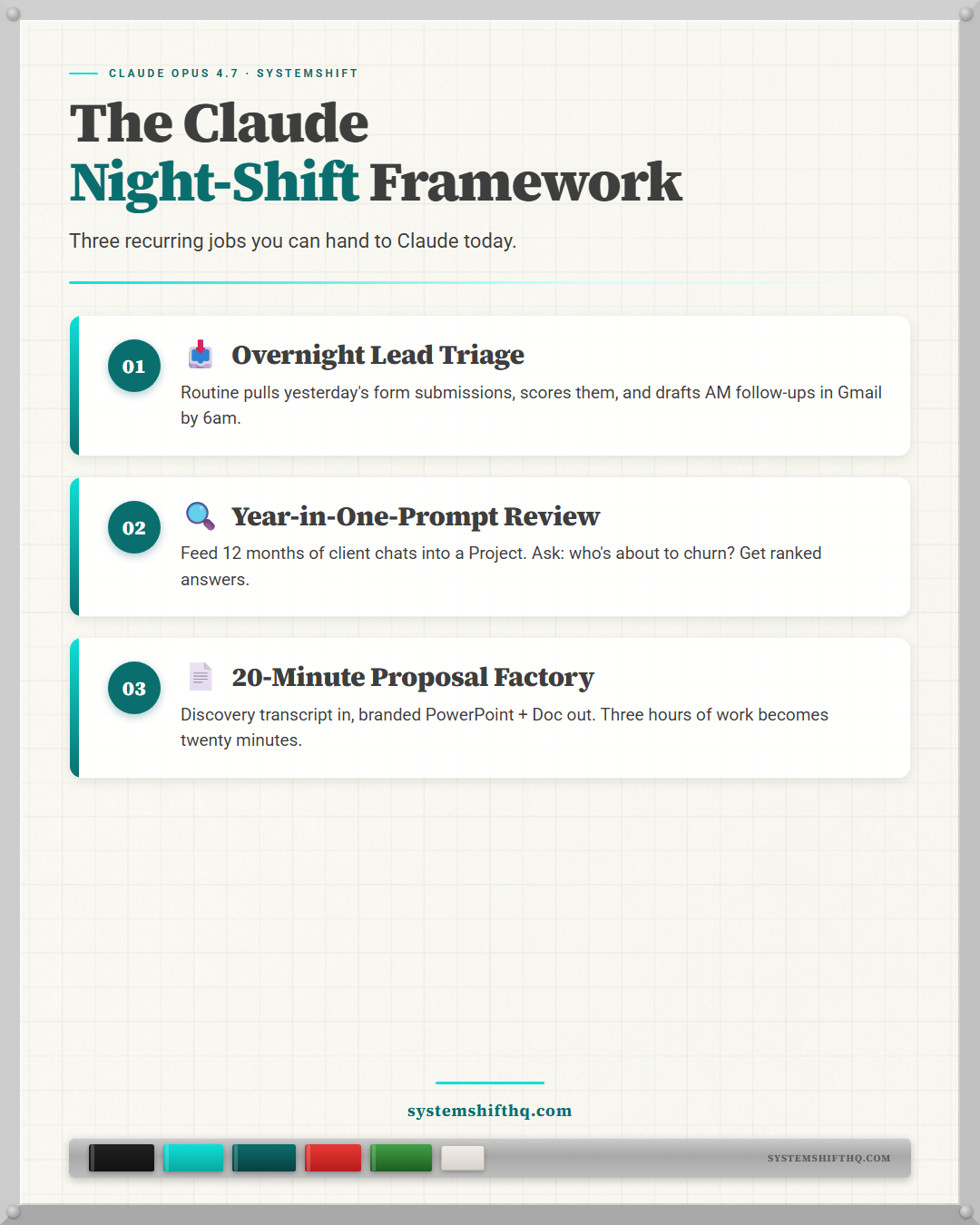
Claude AI for small business owners: the night-shift framework (3 workflows)
Claude AI for small business owners is most useful when you stop using it as a chatbot and start using it as a scheduled operator. The night-shift framework breaks that into three Routines any service owner can ship in a week, each one replacing a recurring task you are doing manually today.
Here's the framework. Pick one. Ship it this week.
The night-shift framework has three slots:
- The 6am Triage (lead follow-up)
- The Sunday Sweep (reputation + review monitoring)
- The Monthly Mirror (customer pattern review)
Each one is a Routine, which is the Anthropic feature that lets Claude run recurring jobs on their cloud while your laptop is off (source). Note: Routines ships inside Claude Code, Anthropic's developer CLI. You set it up once, and it runs on schedule. Pro plan = 5 Routines per day. Max = 15. Team and Enterprise = 25.
Workflow 1: The 6am Triage
Runs every morning at 6am.
Pulls last night's contact form submissions.
Scores each lead by urgency and ticket size.
Drafts a personalized follow-up email for each one.
Drops the drafts into Gmail by 6:01am.
You wake up. Scan. Send. Done before your coffee's cold.
Workflow 2: The Sunday Sweep
Runs every Sunday at 10pm.
Opens Google Maps, Yelp, BBB, your Facebook page.
Pulls any new reviews from the past 7 days.
Drafts a reply for each one, matching your tone.
Logs the star-rating trend into a Google Sheet.
Monday morning, you review the drafts, hit send, and you've got a real-time pulse on your reputation without paying a reputation tool.
Workflow 3: The Monthly Mirror
Runs the 1st of every month.
Pulls 30 days of customer messages, invoices, cancellations.
Feeds it to Opus 4.7 with the 1M context window.
Asks: "Who's about to churn, who's ready for an upsell, what trend did I miss?"
Output lands in your inbox as a one-page brief.
That's three employees running on Claude Opus 4.7 for business. None of them need PTO.
For more plug-and-play agent ideas, see our post on 3 AI agents every business owner can use.
Claude vs ChatGPT April 2026: which wins for service businesses
Claude vs ChatGPT in April 2026 comes down to use case, not quality. For service businesses, Claude Opus 4.7 wins on long-context reasoning, scheduled automation, and Office integration, while ChatGPT wins on creative media (voice, image, video). Most operators end up running both at $20 each.
Here is the April 2026 side-by-side for service owners:
| Capability | Claude Opus 4.7 | ChatGPT (GPT-5.4) | Winner |
|---|---|---|---|
| Long-document reasoning | 1M token context at standard pricing | 128K in consumer tier | Claude |
| SWE-bench Verified | 87.6% | 85.0% | Claude |
| Voice, image, video | Limited | Sora, Voice Mode, DALL-E | ChatGPT |
| Plug-ins / connectors | 50+ | 50+ | Tie |
| Scheduled unattended jobs | Routines (native) | No direct equivalent | Claude |
| Office / Workspace integration | Cowork inside Excel, Sheets, PPT, Gmail, Slack, Drive with shared context (source) | ChatGPT for Work tabs, no shared context | Claude |
| Computer control | Computer Use (GA) | Operator (limited rollout) | Claude |
| Pro plan price | $20/mo | $20/mo | Tie |
Quick read on the scores:
- Reasoning on long documents: Claude wins. 1M context at standard pricing beats anything GPT has in the consumer tier.
- Coding and agent work: Claude wins. 87.6% SWE-bench vs 85.0% for GPT-5.4.
- Voice, image generation, video: ChatGPT wins. Sora, voice mode, image gen are more mature.
- Plug-ins and ecosystem: Tie. Both have 50+ connectors now.
- Running unattended on a schedule: Claude wins. Routines is the feature ChatGPT doesn't have an equal for yet.
- Desktop and Office integration: Claude wins. Cowork sits inside Excel, Sheets, Gmail, PowerPoint, Slack, and GDrive with shared context across all of them.
If you do creative content, keep ChatGPT.
If you run recurring operational work, Claude is the one that just pulled ahead.
Most of my clients run both. They're $20 each. That's not the decision.
The real decision is: which one are you going to set up as a night-shift employee? Right now, only one of them can actually do that job.
Claude AI automation examples you can copy this week
Claude AI automation examples for service businesses fall into five high-leverage categories: overnight lead triage, proposal generation, reputation monitoring, SOP creation, and year-in-one-prompt customer review. Each one replaces work you are currently paying a human (or yourself) to do every week.
Stop thinking. Start copying. Here are five that are working right now:
- Overnight lead triage for HVAC, plumbing, roofing. Form submissions in, sorted and drafted replies out by 6am.
- Proposal factory. Record a discovery call. Feed Claude the transcript plus your pricing deck. 20 minutes later you've got a branded PowerPoint and a Google Doc ready to send.
- Reputation sweep. Claude opens Google Maps, Yelp, BBB weekly via Computer Use and drafts responses to every new review (source).
- Self-updating SOPs. Record a Loom of "how we onboard a new client." Claude converts it to a step-by-step SOP. Every new hire gets the exact same version.
- Year-in-one-prompt customer review. 12 months of data in, churn risks and upsell candidates out.
None of these need code.
None of these need Zapier hell.
None of these need a developer.
Want more recipes? Our business process automation guide stacks these with the workflows you're already running in GoHighLevel or your CRM.
How to use Claude for lead follow-up (no code, 15-minute setup)
How to use Claude for lead follow-up in 15 minutes: upgrade to Claude Pro, connect Gmail, create a Project with your best-converting emails and service menu, then write one Routine prompt that scores and drafts replies every morning at 6am. No code, no Zapier, no developer needed.
Here's the exact 15-minute setup for the 6am Triage.
Minute 0 to 3: Sign in to claude.ai. Upgrade to Pro ($20/mo). Connect your Gmail via the built-in connector.
Minute 3 to 7: Create a new Project. Name it "Lead Triage." Upload three things: a sample of 10 of your best-converting follow-up emails, your service menu with prices, your ideal customer profile in 5 bullet points.
Minute 7 to 12: Write the Routine prompt. Something like:
"Every morning at 6am, pull new messages from my contact form and any unread leads from my Gmail tagged 'website-lead'. For each lead, score it 1 to 10 on urgency and ticket size. Draft a personalized reply using my sample emails as voice reference. Save each draft to Gmail drafts folder. Email me a summary table of all leads with scores."
Minute 12 to 15: Set the schedule. Run it. Test it the next morning.
That's it. You now have a Claude Opus 4.7 for business lead follow-up system that works while you sleep.
If you're running GoHighLevel, pair this with our GoHighLevel automation recipes so the Claude output feeds straight into your pipeline.
The catch (honest tradeoffs)
I'm not going to sell you a fantasy. Here's what's real:
- Pro plan = 5 Routines per day max. If you want more, you're on Max ($100/mo, 15/day) or Team/Enterprise (25/day).
- Computer Use still breaks on weird UI. If the site redesigns, your Routine might fail silently. Check logs weekly.
- Learning curve is real. First Routine takes 2 to 3 hours including testing. By the third one, you're at 15 minutes.
- Pay-as-you-go exists now. When you hit the Pro limit, you can top up at API pricing with a monthly cap. No more "sorry, come back tomorrow" wall.
- Don't feed it your crown jewels blind. Check Anthropic's data policies. Keep sensitive client data scoped to Projects.
Treat Claude Opus 4.7 for business like hiring a smart intern. Train it slowly. Check its work for the first two weeks. Then trust it. That's how you get the 8 to 12 hours back.
For the wider AI toolkit (not just Claude), our list of best AI tools for small business is the companion read.
Want this running in YOUR business? Let's build it.
You can read 50 blog posts and still be stuck. Or we can build your first Claude Opus 4.7 for business Routine together this week.
SystemShift hands owner-operators a set of AI operators that run the recurring stuff. Lead triage, follow-up, review responses, monthly reviews. Boring, repeatable, revenue-moving work.
No code. No Zapier spaghetti. No hiring a dev.
Here's what to do next:
- See the stack: Meet our SystemShift AI agents. These are the same pre-built operators we deploy for clients.
- Book a call: Tell us what you're stuck on. Reach out here and we'll show you exactly what your night-shift looks like.
The ceiling just moved.
The question isn't whether Claude can run your night shift.
It's whether you're going to hire it before your competitor does.
Ready to Automate Your Business?
Book a free strategy call and we'll map out exactly what to build first.
Book Your Call
Join the Conversation