

- 82% of agents use AI, but only 17% say it made a significant difference. The gap is where they point it.
- Layer 1 is content (listing copy, social, email). It saves typing. It does not change your closings.
- Layer 2 is lead response (instant replies, inquiry updates, adaptive follow-up). This is where the money is.
- Layer 3 is the back office (listing prep, transaction coordination, database reactivation). This is where your evenings come back.
- Start with Layer 2. One inquiry that gets answered in 60 seconds instead of 15 hours pays for everything else.
Eighty-two percent of real estate agents now use AI in their business. That number comes from RPR's February 2026 survey of NAR members, and it is up from roughly 15% in 2023.
Here is the number that never makes it onto the slide. In NAR's own 2025 Technology Survey, only 17% of agents said AI had a significant positive impact on their business. Forty-six percent said it made no noticeable difference at all.
So four out of five agents are using it, and fewer than one in five can feel it. That is not an adoption problem. That is an aiming problem.
Where AI for real estate agents goes wrong
Look at what agents actually use it for. In the RPR survey, the top three uses were writing listing descriptions (68%), creating social media content (59%), and drafting emails (53%). Writing tools sit near 78% adoption. Chatbots and assistants, the tools built to actually talk to a lead, sit closer to 47%.
That means the average agent has AI writing their MLS copy while their inbound leads sit unanswered. Inman's 2025 technology survey put the average agent's lead response time at 917 minutes. That is more than fifteen hours. Meanwhile the MIT lead response study, which gets replicated every few years and keeps saying the same thing, found that a lead contacted within five minutes is 21 times more likely to qualify than one contacted at thirty minutes.
You cannot write your way out of a fifteen hour response gap. A prettier listing description does not change whether the buyer who clicked it at 9:40 last night still cares at lunch tomorrow.
Here's the thing. AI is not one tool. It is three different jobs, and they pay very differently. Once you see the layers, you know exactly where to point it first.
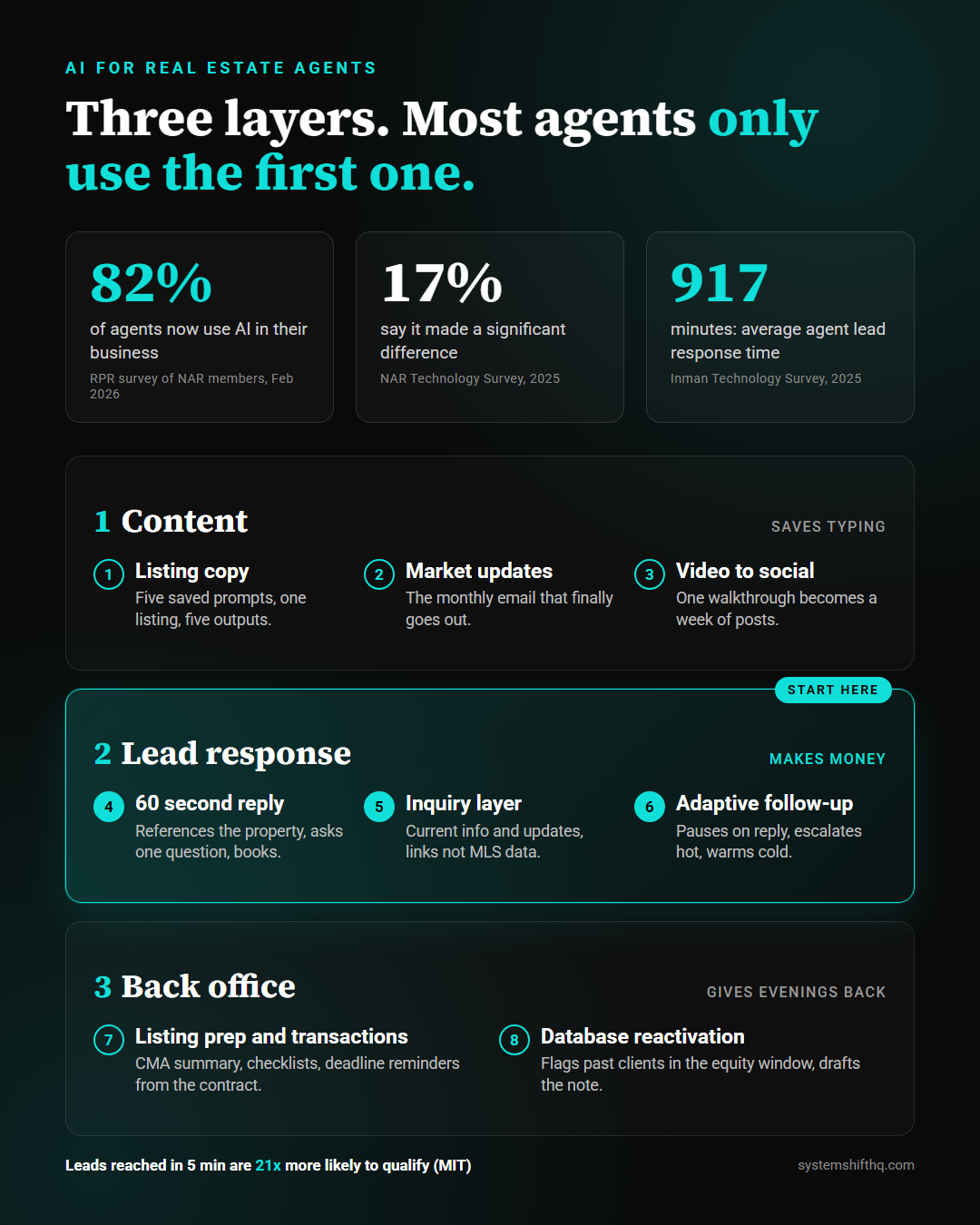
Layer 1: Content (where 82% of agents already are)
This is the layer everyone starts in because it is the easiest to try. You open ChatGPT, paste in the property details, and get a description back. It works, and it is worth doing. Just understand what it buys you.
1. Listing copy from one set of prompts
A polished MLS description used to take 20 to 30 minutes. With a tuned prompt it is a two minute first draft and a three minute edit. Do the math across a team doing 200 listings a year and that is roughly 80 hours back.
The upgrade most agents miss is that one listing should produce five pieces, not one. Build five saved prompts: the MLS description, the social caption, the just-listed email, the property page copy, and the postcard. Run every listing through all five. That is one input, five outputs, and fifteen minutes of your time.
2. Market updates and neighborhood content
The monthly market update email that you meant to send for two years now takes ten minutes. Paste in the local numbers, tell the AI who the reader is (a homeowner in a specific zip code who might sell in the next 18 months), and it drafts a plain-English version. You add the one sentence of your own opinion that makes it yours, and it goes out.
3. Video scripts and social from one source
Record a three minute walkthrough on your phone. Feed the transcript to AI and ask for a 30 second script, three captions, and a short email. One piece of raw footage becomes a week of posts.
Layer 1 is real. It is also where the 46% who felt nothing live. Content saves typing, and typing was never the bottleneck.
Layer 2: Lead response (where the money is)
This is the layer that separates the 17% from everyone else. It is also the layer most agents skip, because it takes a system rather than a chat window.
4. The 60 second first response
Every inquiry, from every source, gets a personal reply in under a minute, at any hour. Not "Thanks for reaching out!" but "Hey, saw you were looking at the place on Elm. It is still available. Are you looking to see it this week or just getting a feel for the area?"
That reply references the actual property, asks one qualifying question, and offers a next step. The lead answers, and the conversation continues with the same context until it is time for you. When it is, the system books directly onto your calendar and hands it off with the full thread attached.
The 2026 Inman Lead Conversion Report found brokerages running an AI-first qualification stack closed about 3.4 times more deals per lead than those relying on human follow-up alone, and nearly all of that lift came from speed to first response. That is the whole game in one number.
5. An inquiry layer on your listings
Most people call this one a chatbot, and it is not. It is an automation layer. When someone inquires about a property, they get current information and updates on what they are looking for, delivered as links back to the listing rather than data pulled out of the MLS. That keeps you on the right side of IDX rules and keeps the buyer coming back to your site instead of Zillow.
The buyer who asked about a three bedroom in a specific school district gets a message when a new one hits. The one who asked about a house that went under contract gets told, and gets two alternatives. Nobody has to remember. We built exactly this for agents, and you can see how it works at realestate.systemshifthq.com.
6. Follow-up that adapts instead of blasts
Most follow-up automation is a 47-text drip that treats every lead the same. Adaptive follow-up pauses the moment a lead replies, escalates the hot ones to you, and keeps the cold ones warm with a different angle every touch: a market update, a similar listing, a neighborhood comp. Hot leads never get a canned text after they have already answered, and cold leads never get dropped after day three.
If you want the step by step on building this, I broke down the full sequence in speed to lead automation. The same logic applies whether your CRM is GoHighLevel, Follow Up Boss, kvCORE, or something else. We built a connector that pushes GHL leads straight into Follow Up Boss for exactly this reason: the response system should not care where the lead came from.
Layer 3: The back office (where your evenings come back)
The RPR survey found 34% of agents save more than four hours a week with AI. This is the layer that gets you there.
7. Listing prep and transaction coordination
Between "I signed the listing agreement" and "we are live on the MLS" there is a pile of admin nobody enjoys: the comp pull, the disclosure checklist, the photographer booking, the showing feedback nobody reads. AI drafts the CMA summary from your comps, builds the pre-listing checklist from your template, and turns twelve showing feedback emails into three sentences you can actually send to the seller.
On the transaction side, contract to close runs on deadlines. The system we build reads the executed contract, pulls the dates, and sends the reminders to the right party three days before each one. That covers the inspection contingency, the appraisal, the loan commitment, and closing, with no spreadsheet and no 2 a.m. panic about a date that already passed.
One rule here: AI drafts, you verify. A CMA summary is a starting point for your judgment, not a replacement for it. The agents who get burned are the ones who let the draft go out unread.
8. Database reactivation
Your past clients are the most profitable leads you will ever have, and most agents talk to them twice a year by accident. An AI assistant working inside your CRM can flag the homeowner who bought five years ago and is now in the equity window, draft a personal note referencing their specific street and the recent sale two doors down, and queue it for your approval.
You still hit send. You just no longer have to remember who to send it to.
The ai tools for real estate agents question
Everyone asks which tool. The honest answer is that Layer 1 runs on ChatGPT, Claude, or Gemini and a set of saved prompts, and you should not pay for a "real estate AI writing tool" that is a thin wrapper around one of those. NAR's survey had ChatGPT at 58% of agents, Gemini at 20%, and Copilot at 15%, and that is fine for content.
Layer 2 and Layer 3 do not run on a chat window. They run on your CRM plus an AI layer that reads and writes to it. That is a system, and it is why most agents stop at Layer 1. The chat window was free and it was right there. The system takes a week to set up and a decision to make.
What to do this week
Do not start with content. You already have that.
First, time yourself. Send a test inquiry through your own website and your Zillow profile at 9 p.m. tonight and note when the first human reply lands. If the answer is "tomorrow," you found your highest paying project.
Second, pick one source. Do not automate everything. Take the single lead source that produces the most inquiries and wire a 60 second response to it, with one qualifying question and a calendar link. Run it for two weeks and read every conversation.
Third, only after that is working, build the five listing prompts and the contract deadline system. Layer 1 and Layer 3 are worth having. They are just not worth having first.
The 17% are not smarter and they are not using a secret tool. They pointed the same AI at the part of the business that touches money, and everyone else pointed it at the part that touches typing.
If you want the Layer 2 system built for your brokerage, this is what we build for real estate agents. Or just book a call and bring your response time number. I will tell you exactly what it is costing you.
FAQ
What is the best AI for real estate agents to start with?
Start with your CRM's response layer, not a writing tool. Wire a 60 second personalized reply to your highest volume lead source, with one qualifying question and a calendar link. For content, ChatGPT, Claude, or Gemini with five saved listing prompts is enough. You do not need a paid real estate AI writing wrapper.
Do AI agents for real estate violate IDX or MLS rules?
They do not, as long as they are built correctly. The safe pattern is an inquiry layer that returns links to the listing on your site rather than pulling listing data into the conversation. The buyer gets current updates and lands back on your page. Talk to your MLS about display rules before you let any tool quote listing data directly.
How much time does AI actually save a real estate agent?
RPR's February 2026 survey found 68% of agents save at least one hour a week and 34% save more than four. The agents at the top of that range use AI for lead response and transaction admin, not just listing descriptions.
Ready to Automate Your Business?
Book a free strategy call and we'll map out exactly what to build first.
Book Your Call
Join the Conversation