

Gartner says over 40 percent of agentic AI projects will be canceled by the end of 2027.
Not because the tech is bad. Because nobody could prove the agent was working.
Escalating cost. Unclear value. No risk controls. That is the Gartner list, and it is the same list I see when I audit an agency's stack. They built an agent. It produces stuff. And when I ask the one question that matters, they go quiet.
The question is simple. Is it working? Not "does it run." Working. And most owners cannot answer it, because they never set up the test.
Let me give you the test.
What AI Agent Evaluation Actually Means
AI agent evaluation is not "did the agent reply." That is the trap. An agent that replies with confident garbage looks identical to an agent that nails the task, right up until it costs you a client.
Evaluation means measuring whether the agent produces the outcome you hired it for, at a cost you can live with, without a human babysitting every run. That is it. Outcome, cost, autonomy.
A chatbot that answers is not an agent that works. An agent that works is one you can leave alone and trust the result. The only way to earn that trust is to measure it. Four numbers do the job.
The 4-Metric Test
These are the AI agent evaluation metrics I run on every agent in our stack. Twenty-seven agents, same four numbers.
Metric 1: Cost per task.
Not your monthly AI bill. The cost of one completed outcome. One proposal drafted. One lead followed up. One blog researched. Divide the spend by the number of real outcomes and you get a number you can compare against a human doing the same job. If your Closer agent drafts a proposal for two dollars and a VA does it for forty, you have your answer. If the agent costs more than the human and does the same work, you do not have an agent. You have a toy.
Metric 2: Success rate.
Out of the last hundred runs, how many produced a usable result on the first pass? Not "ran without an error." Usable. A result you would actually send, ship, or act on. An agent at 90 percent success is a teammate. An agent at 55 percent is a coin flip you are paying for, and you are doing the QA either way.
Metric 3: Recovery rate.
When the agent hits a wall, how often does it recover on its own versus stopping and pinging you? This is the metric everyone skips, and it is the one that decides whether the agent saves you time or just moves the interruption around. An agent that fails and self-corrects is autonomy. An agent that fails and waits for you is a slightly fancier form of manual work.
Metric 4: Output validation pass rate.
Before the agent's work reaches you, does it check its own output against a standard? Right format, required fields present, no placeholder text, no hallucinated numbers. The pass rate on that self-check tells you how much trust you can hand over. High pass rate, you skim and approve. Low pass rate, you are the validation layer, and the agent just gave you a second job.
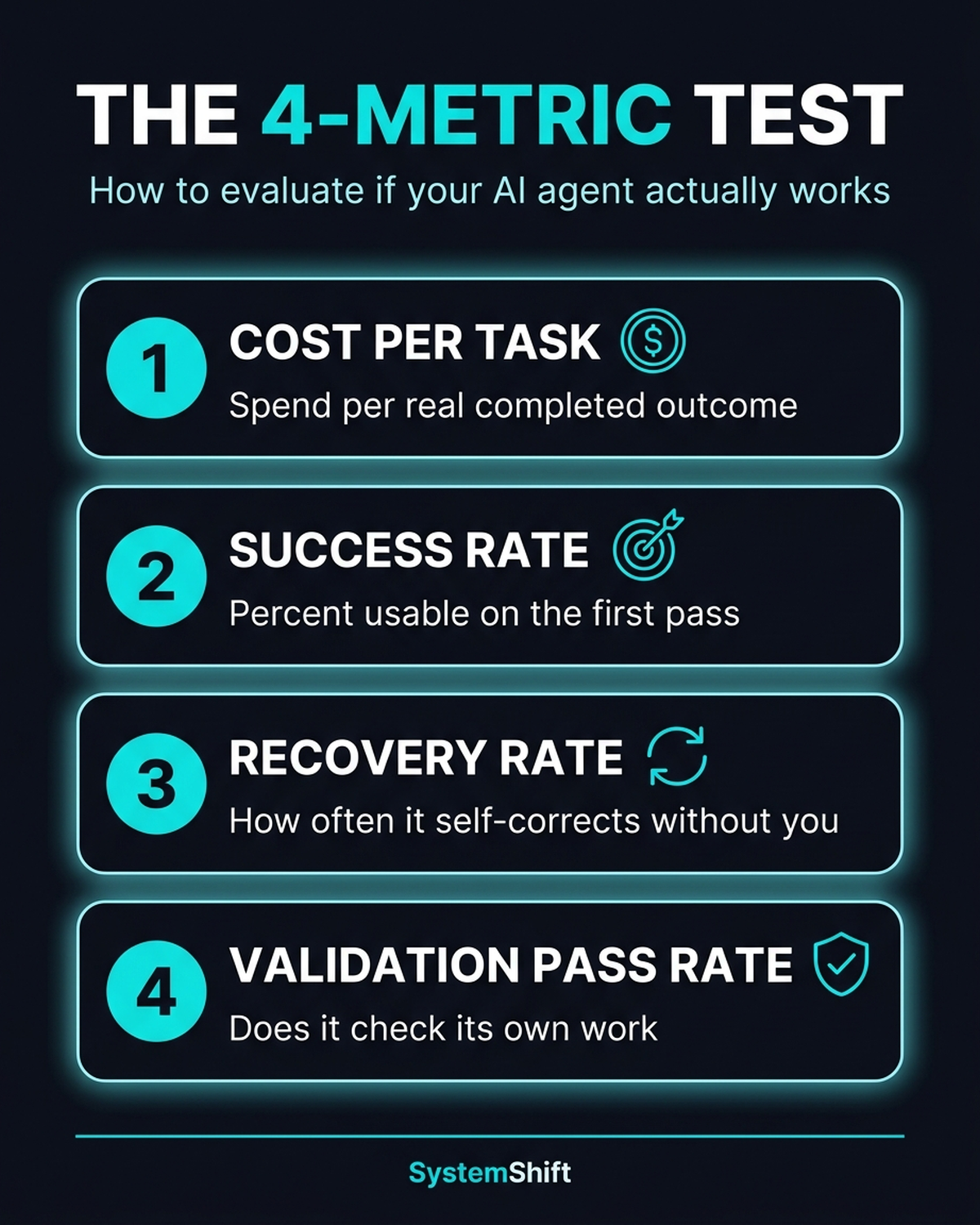
Four numbers. Cost, success, recovery, validation. Put them on one line and you can evaluate any agent in ten seconds. Green across the board, keep it. A red anywhere, that is your next fix.
How to Evaluate AI Agents Without a Dashboard
You do not need an observability platform to start. You need a log.
Here is the system we run, and it costs nothing but discipline. Every agent in our stack keeps a small set of memory files. One of them is an errors log. Every time an agent fails a task, the failure gets written down with the cause and the fix. Plain text. Nothing fancy.
The trick is a recurrence count. When the same failure shows up a second time, we bump a counter instead of writing a duplicate. When that counter climbs, the pattern graduates from "a thing that went wrong once" into a rule the agent follows every time after.
That is evaluation that improves the agent instead of just grading it. Your success rate goes up because repeat failures get converted into rules. Your recovery rate goes up because the agent has seen the wall before. You are not just measuring the four metrics. You are moving them.
If you are running your agents as one giant prompt, none of this is possible. There is nothing to log against, no place for a rule to live. This is the same reason Claude Skills replaced my prompt library: a modular agent has a memory and a structure you can measure. A prompt in a chat window does not.
The Agent-Washing Trap
There is a reason so many owners cannot answer the "is it working" question. They got sold on activity, not outcomes.
Agent-washing is everywhere. A vendor wraps a single API call in a nice UI, calls it an agent, and charges you monthly. It produces output. It feels alive. And because it never stops producing, you assume it is producing value. Gartner estimates only about 130 of the thousands of agentic AI vendors on the market are the real thing.
The four-metric test cuts straight through that. Run any tool against cost per task, success rate, recovery rate, and validation pass rate. If the vendor cannot give you those numbers, or the numbers are bad, you found your answer. A real agent survives the test. A wrapper does not.
This is exactly how we audit before we build. We covered the 3 AI agents every business owner can use with this same lens, and the ones worth keeping are the ones that pass on all four.
Why This Matters for Service Businesses
If you run a service business, you do not have a research team to babysit an AI experiment. You have leads to chase and jobs to run. An agent that you cannot evaluate is not a helper. It is a risk you cannot see.
The four-metric test turns your AI from a leap of faith into a line item you can defend. You know what each agent costs per outcome. You know how often it lands. You know when it needs you and when it does not. That is the difference between "we are trying some AI stuff" and "we replaced a task with a system that pays for itself."
It also tells you when to stop. An agent that fails the test is not a sunk cost you keep feeding out of guilt. It is a clear no. Kill it, fix it, or replace it. That decision is only hard when you have no numbers. With the four, it is obvious.
This is the same systems-first move behind the real ROI of AI automation for small business and every agent we ship. Build it, measure it on four numbers, keep it only if it earns its seat.
Frequently Asked Questions
What is AI agent evaluation in plain English?
AI agent evaluation is measuring whether an AI agent produces the outcome you hired it for, at a cost you can accept, without a human checking every run. It is not "did it reply." It is "did it do the job, and can I trust the result." Four metrics answer that: cost per task, success rate, recovery rate, and output validation pass rate.
How do you measure AI agent performance?
Track four numbers over the agent's last hundred runs. Cost per completed outcome. Percentage of runs that were usable on the first pass. Percentage of failures the agent recovered from on its own. And the rate at which the agent's self-check catches its own errors before the work reaches you. Put them on one line and you can evaluate any agent at a glance.
What AI agent evaluation metrics actually matter?
Cost per task, success rate, recovery rate, and validation pass rate. Skip vanity metrics like number of messages or tasks attempted. Those measure activity, not value. The four above measure whether the agent is an asset or a liability.
Do I need a special tool to evaluate AI agents?
No. Start with a plain-text log. Record every failure with its cause and fix, and keep a recurrence count so repeat failures graduate into rules. That alone raises your success and recovery rates. Dedicated AI agent monitoring tools help at scale, but the discipline matters more than the dashboard.
How do I know if an AI agent vendor is real or just agent-washing?
Ask for the four numbers. A real agent vendor can tell you cost per outcome, first-pass success rate, recovery behavior, and validation pass rate. A wrapper dressed up as an agent cannot, or the numbers fall apart under the question. The test does the filtering for you.
Bottom Line
You cannot manage what you refuse to measure, and most AI agents are running completely unmeasured. That is why 40 percent of these projects are heading for the trash by 2027. Not bad tech. No scoreboard.
Set up the scoreboard. Cost per task, success rate, recovery rate, validation pass rate. Four numbers, one line, ten seconds to read. Green across the board, you have a teammate. Red anywhere, you have your next fix.
That is AI agent evaluation. Not a feeling. A test.
Want us to run the four-metric test on your stack and tell you which agents are earning their seat? Book a SystemShift call and we will audit what you are running and hand you the rubric.
Ready to Automate Your Business?
Book a free strategy call and we'll map out exactly what to build first.
Book Your Call
Join the Conversation